
Led by Richard Beggs @RbeggsDL
All too often these days we are bombarded with the latest news on Generative AI, from being replaced as educators by bots to students using emerging tools to write assignments. I often wonder if we are caught up in the hyperbole of companies trying to sell their wares. Don’t worry, I am not going to go down the path explaining Generative AI, when just a few short weeks ago Gerhard Kristandl did such an excellent job on this already. What I am going to explore is how storytelling can potentially act as an antidote to the current AI rhetoric and bring the human aspect to the forefront.
My Storytelling Awakening
Whilst studying Visual Communication at the Art College in Belfast (Now known as Belfast School of Art, Ulster University) in the late 1990s I often used storytelling as a tool to enhance the poster, magazine, website or interactive objects I was designing as part of my student projects. This continued into my professional career when I worked in design agencies and software companies, using storytelling to help sell the clients’ product or service. For me, storytelling has been central to everything I do. Even now as a senior lecturer in HE Practice I utilise storytelling methodology to explain complex concepts, influence others or to demonstrate impact, but where did my interest in storytelling come from and is it useful to Higher Education learning and teaching practice?
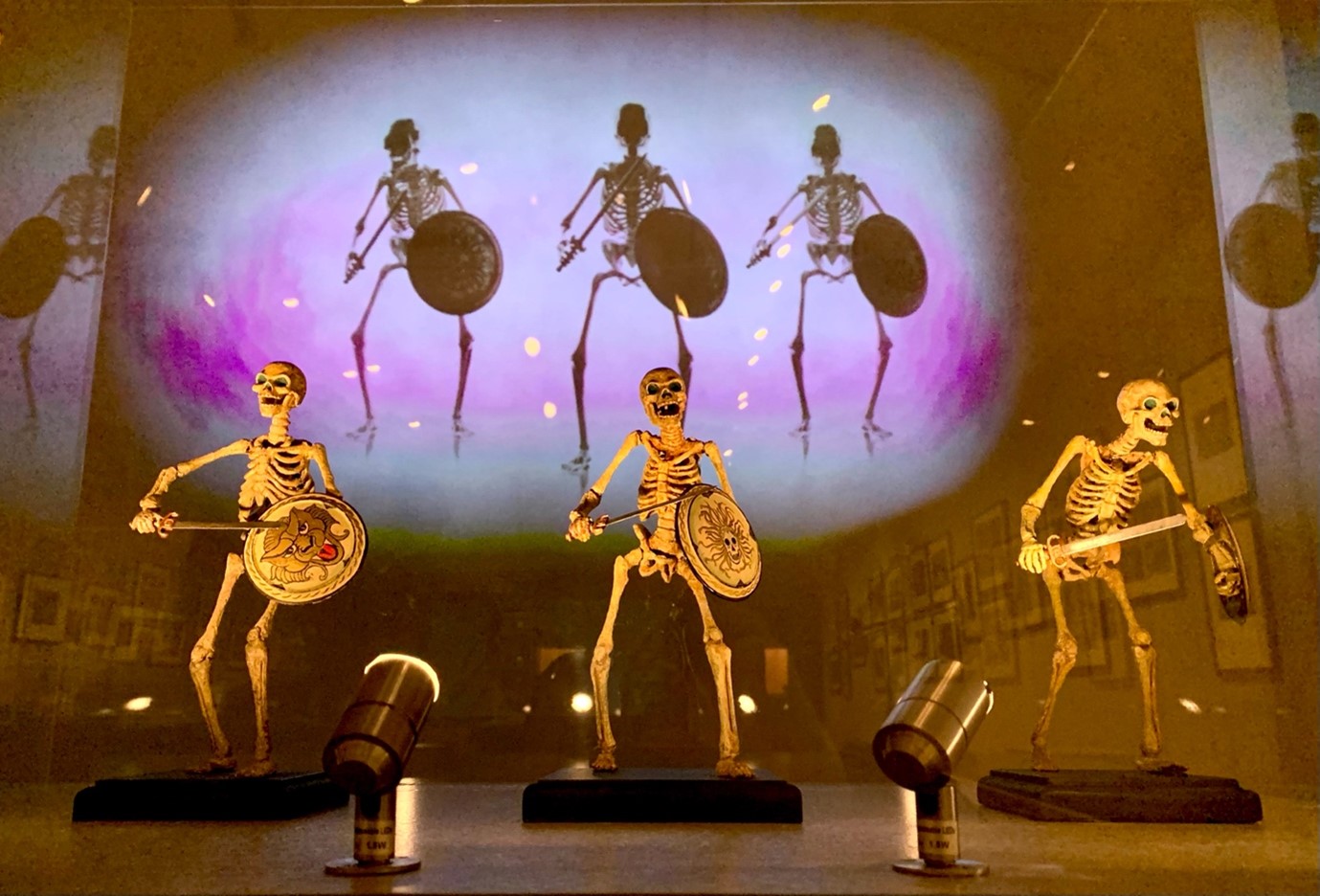
Growing up in the 1980’s in Northern Ireland it was quite a troubled period in history. On a nightly basis the TV news was constantly showing the devastation caused by bombs and tragedies, I was terrified. Reflecting on this as an adult I now realise that I sought to escape the world around me through watching tv shows or movies and immersing myself in my Commodore Vic-20 computer. I would spend hours watching re-runs of Lost in Space, Land of Giants and any other fantasy and science fiction shows I could find. Movies were also very important, “Star Wars”, “Indiana Jones”, “Superman”, however the standout memories of stories and going on an adventure were from the movies of the late and great Ray Harryhausen. From “The 7th Voyage of Sinbad” and “One million Years B.C.” to “Jason and the Argonauts”. One movie that sticks with me to this day is “Clash of the Titans”, which is probably due to the fact that it was released within my lifetime. This is where I became aware that emotion was a powerful tool in storytelling. Ray Harryhausen was probably the first person to successfully bring his animated creatures to life, they felt pain, love, joy and sorrow and the audience believed they were real.
My other passion and vessel for escapism was my Commodore Vic-20, my first personal computer. Quite basic (no pun intended) in today’s terms, but at the time it was state-of-the-art and I loved it. I would spend countless hours playing chess against the computer, playing video games, granted a lot of the time was waiting for the games to load from the cassette. However, what I waited for with bated breath was my Input magazine that my dad purchased from the local newsagents. It was fantastic, it walked through the foundations of programming in Basic, the hardware and the peripherals I could add to my Christmas list, but the thing I enjoyed the most was animating and illustrating using ASCII characters. Each issue came with a tutorial to follow, where I typed the printed code and hit run to watch an ASCII animation. Most of the time I got an error either through a typo on my part or that of the publisher. They often printed an addendum in the next issue of where the typo was to be found. This is where my problem-solving skills were developed at an early age as I didn’t have the patience to wait for the next issue to see the animation I had spent hours setting up. As with storytelling my digital skills have continued to be critical to my career, but I often found it difficult to combine them in my roles in Higher Education. Until I discovered digital storytelling.
What is Digital Storytelling?
The term was originally coined by Dana Atchley and his work along with Joe Lambert and Nina Mullen in the 1980s and 1990s led to the creation of the Center for Digital Storytelling (McLellan, 2007) and the Digital Storytelling Cookbook (Lambert, 2010). It is widely agreed that Digital Storytelling in its basic terms uses recorded spoken word, supplemented with photographs, text or imagery that are combined in a short video file which can range from 2-5 minutes. Daniel Meadows described them as radio with pictures (Meadows, 2003) which is a very apt description of a digital story. Chris Thomson (Thomson, 2020) from Jisc did a lot of work in the last few years promoting its use in education and research across the UK and it is from him where my eureka moment was born, and my storytelling and digital passions fused together. So began my digital storytelling journey.
When working within academia you always get asked who else has done this, is it effective, how do you know it works? An evidence-based approach is paramount. As I mentioned Chris Thomson was key in influencing in my practice and he directed me to the University of Strathclyde in Glasgow, Scotland, who have been utilising digital storytelling for a while in higher education (Strathclyde, 2017) particularly around creating and sharing stories about research. Liz Austen, Nathanial Pickering, and Marie Judge explored if digital storytelling was a useful reflection tool and mode to convey students’ HE transition stories (Austen et al, 2021). An example of an emotive digital story I collaborated on with a colleague, Maire Braniff can be watched online.
How can Digital Storytelling be used in HE?
From my experience the process of creating digital stories enhances digital capabilities and reflective practice (Alexandra, 2008), promotes creativity, self-reflection, planning and concise writing skills (Beggs, 2022 & McLellan, 2007). The authentic approach to building a digital story, through emotive script writing, storyboarding, using your own images and voice isn’t something that AI can currently replicate, and this is where the human aspect of creating a story becomes invaluable. I have used digital storytelling in staff CPD workshops, brought into assessments at undergraduate and postgraduate courses and utilised in initial teaching training at Ulster University. Valuing the potential impact that digital storytelling could have on education I have jointly created a Jisc community with colleagues from Durham University and Jisc. If you want to share your story or just to listen to others’, please get involved.
I have told my story which is a cumulation of my experiences, is it authentic, I think so. Is digital storytelling an antidote to Generative AI in Higher Education? Only time will tell.
References
Alexandra, D. (2008), ‘Digital storytelling as transformative practice: Critical analysis and creative expression in the representation of migration in Ireland’, Journal of Media Practice 9: 2, pp. 101-112, doi: 10.1386/jmpr.9.2.101/1
Liz Austen, Nathaniel Pickering & Marie Judge (2021) Student reflections on the pedagogy of transitions into higher education, through digital storytelling, Journal of Further and Higher Education, 45:3, 337-348, DOI: 10.1080/0309877X.2020.1762171
Beggs, RTG. Digital Storytelling: encouraging active learning through collaborative team projects (2022) 100 Ideas for Active Learning. Open Press Sussex University https://doi.org/10.20919/OPXR1032/55
Meadows, D. (2003). Digital Storytelling: Research-Based Practice in New Media. Visual Communication, 2(2), 189–193. https://doi.org/10.1177/1470357203002002004
University of Strathclyde. (2017). Your research is a story…so why not learn how to tell it? https://ewds.strath.ac.uk/storytelling/Home.aspx
Thomson, C. (2020, September 22). Add digital storytelling to your online learning toolkit. Jisc. http://inspiringlearning.jiscinvolve.org/wp/2020/09/digital-storytelling-online-learning/
Lambert, J. (2022). StoryCenter: Listen Deeply Tell Stories. Center for Digital Storytelling. https://www.storycenter.org/
Lambert, J. (2010). Digital storytelling cookbook. Digital Diner Press. https://lthechat.com/wp-content/uploads/2024/11/031c7-cookbook_full.pdf
McLellan, H. Digital storytelling in higher education. J. Comput. High. Educ. 19, 65–79 (2007). https://doi.org/10.1007/BF03033420
Author Biography

Richard Beggs, NTF, PFHEA, CMALT is a Senior Lecturer in Higher Education Practice at Ulster University based in the Centre for Curriculum Enhancement and Approval. Richard has led several initiatives at Ulster University that have transformed student learning experiences such as Apps for Active Learning, Digital Storytelling, Student Learning Partners, Active Learning Champions and Learning Landscapes. He leads Ulster University’s Advance HE Fellowship Accreditation and also teaches on the MEd in HE Practice programme. Outside of Ulster Richard is the Chair of the ALT Active Learning Special Interest Group, a Jisc Community Champion, Co-Lead Jisc Digital Storytelling Community, a member of the Active Learning Network and an Advance HE Accreditor.


 #LTHEchat