
Led by Chris Martin @Linguist1980
The landscape of higher education in the UK is as diverse as its student population. As many students come from varied cultural, socioeconomic, and educational backgrounds, understanding what makes them tick and their psychology as learners could be key to fostering academic success and personal growth. This blog post aims to introduce readers to three key psychological theories that could be applied to our learners in higher education: Self-Determination Theory (SDT) (Ryan & Deci, 2000), Expectancy-Value Theory (Wigfield & Eccles, 2000) and Wellbeing Theory (Seligman, 2012).
One key area of learner psychology is that of motivation and engagement. There is a growing emphasis being placed on the application of Self-Determination Theory (SDT) within educational settings (Dimitriadou et al., 2023; Neufield, 2023; Zhou & Zhang, 2023). The theory was pioneered by Ryan and Deci (2000), who posit three key forms of motivation: amotivation, extrinsic motivation and intrinsic motivation.
Amotivation: Amotivation occurs when an individual has no desire or wish to participate in a task or pursue an activity. This may be due to a disconnect between the individual and content – the individual sees no value in completing the task or may not feel competent enough to complete the task without support. Amotivation may lead to negative outcomes such as anxiety, aggression, and depression when faced with tasks or activities that the individual does not wish to undertake. This would have a negative impact on the individual’s wellbeing and may lead to creating a contiguous pair (when two things occur repeatedly, leading to an association e.g., assessment periods and anxiety).
Extrinsic Motivation: Extrinsic Motivation can be viewed in multiple ways. The overarching definition is that an individual is motivated by external means (e.g., reward, praise). If an individual is externally regulated, this means that their motivation comes from external sources (e.g., parents offering gifts for doing well, rewarding them with praise). If any of these external sources are removed, the individual risks becoming demotivated. If an individual displays introjected regulation, this means that the individual could be motivated by obligation or guilt. For example, a student just flying under the radar and not performing as well as they could when they see others doing well may feel a sense of guilt and would, therefore, be motivated to do better. Extrinsically motivated individuals tend to attribute their success or failure at a task to external factors e.g., task difficulty, pure luck on the day.
Intrinsic Motivation: This form of motivation is considered the more desirable form of motivation within educational settings. Intrinsically motivated individuals are those who feel a sense of excitement or desire when participating in a task or activity. These individuals feel competent and have autonomy/agency over the task at hand, and they feel connected to the task, their surroundings, and their peers. They also see a value to participating in an activity or completing a task. Intrinsically motivated students tend to attribute their success or failure at a task to internal factors, e.g., effort, willpower, and ability.
For an individual to be intrinsically motivated, three psychological conditions need to be met: Autonomy, Competence and Relatedness. Autonomy refers to the ability to feel a sense of agency or control over a particular task or behaviour. It involves being able to make one’s own decisions and a feeling of independence. Competence relates to having the required skills, intellect, and qualities to perform a given task. Someone who feels competent has a sense of mastery over the task/activity at hand. Finally, relatedness is about fulfilling the need to have close relationships and a sense of belonging to a social group, in this case, peers in the classroom. Without relatedness, an individual would feel disconnected from their surroundings and would lack support and help from their social group, making self-determination difficult to achieve (Ryan & Deci, 2000).
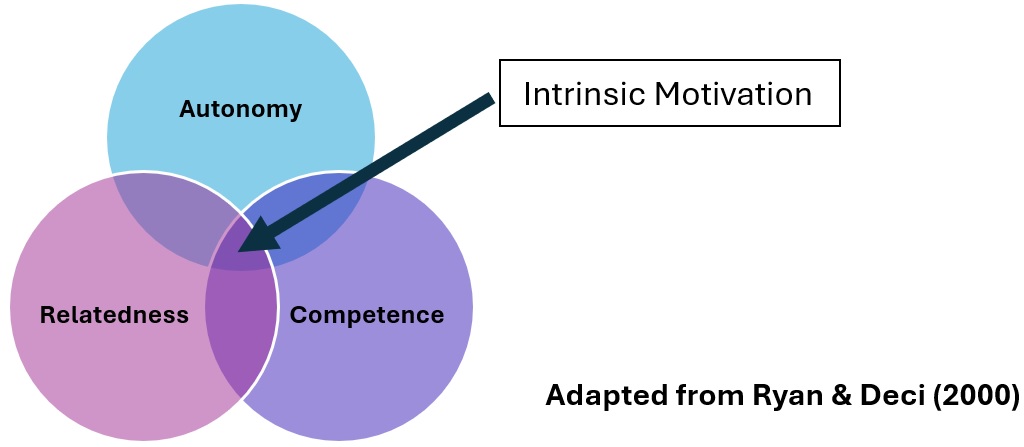
When considering the design of student learning experiences, it is helpful to keep these three conditions in mind, particularly when designing assessments. Authentic assessments, for example, provide students with the flexibility to approach an assignment that makes them feel the most competent and to make their own judgments about the information contained within and the format in which the assignment is presented (McArthur, 2022). When students see that their peers are also fully engaged with the assignment, this supports the condition of relatedness.
Expectancy-Value Theory
This is an additional motivational theory, pioneered by Wigfield & Eccles (2000), that explains how an individual’s expectancy to succeed and the perceived value of the task at hand impact on the level of effort that is put in to complete the task. If an individual goes into a task feeling prepared and competent and expects to do well as well as seeing the value of doing well, there is a strong likelihood that they will have a favourable outcome.
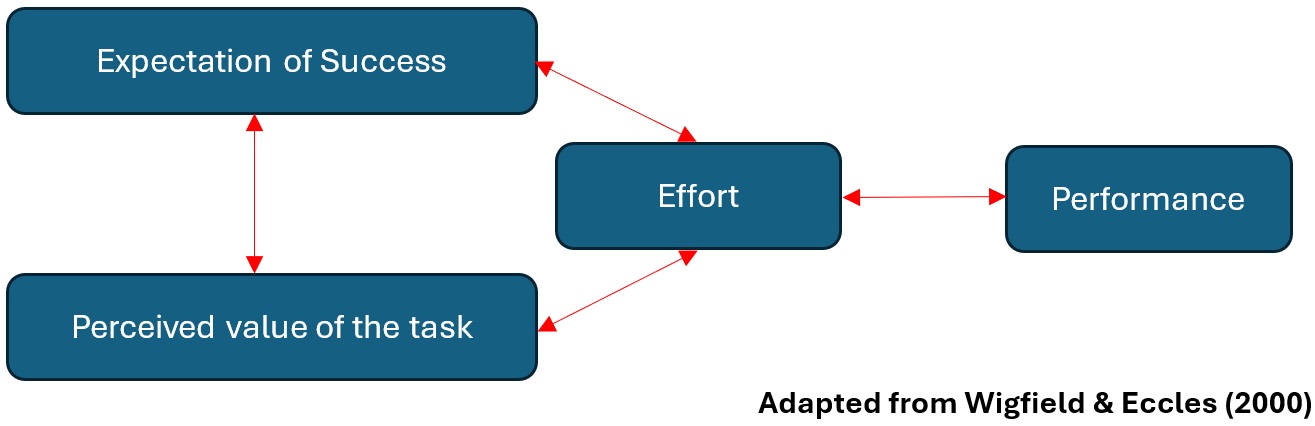
Achievement-related choices are motivated by a combination of people’s expectations of success and subjective task value. Task value can be broken down into four sub-levels: attainment value (the importance of doing well), intrinsic value (personal enjoyment), utility value (perceived usefulness towards goals) and cost (time investment and competition with other goals). Expectations for success are strongly correlated with performance, i.e., students who expect to do well tend to perform well compared to those who do not expect to do well.
The Role of Positive Psychology in the Classroom
‘Positive Psychology helps to foster happiness and emotional wellness. It does it by helping individuals to capitalise on their strengths, heighten their gratitude and awareness, connect to others, and develop the wisdom needed to live a more meaningful and fulfilling life’ (Harvard Medical School, 2023).
Positive Psychology is a nascent field of psychology that focuses on individuals’ well-being and happiness in their daily lives. One key theorist within this field is Martin Seligman (2012), who pioneered the PERMA+ Theory. PERMA+ is an acronym that stands for:
Positive emotion (hope, interest, joy, love, pride)
Engagement (loss of self-consciousness – total absorption in the task)
Relationships (partners, peers, friends, mentors, the wider community)
Meaning (sense of value and worth, having meaning/purpose)
Accomplishments (achievements, mastery, competence)
+ (sleep, nutrition, physical activity)
Links with Self-Determination Theory
This theory links extensively to Self-Determination Theory (SDT) (Ryan & Deci, 2000) which stipulates that, for an individual to be intrinsically motivated, three psychological conditions need to be met: autonomy, competence, and relatedness. When considering PERMA+ theory association with SDT, Seligman’s reference to ‘relationships’ links clearly with ‘relatedness’ of SDT – an individual feels connected to their environment and those around them. In addition, ‘Accomplishments’ are linked with ‘competence’ – an individual is motivated when they feel a sense of achievement and competence when doing a task. Finally, ‘Engagement’ could be linked to ‘autonomy’ – an individual is agentive in completing the task, being completely absorbed and not requiring much (if any) guidance.
Possible recommendations for practice
When designing learning experiences or engaging with students in personal tutoring, for example, consider ways of empowering the student to showcase their accomplishments, experience a sense of achievement, possibly through praise, and demonstrate the value of their learning in securing future employment. Students are more likely to put more effort into their work when they can see clear value in doing the task (cf. Expectancy-Value Theory, Wigfield & Eccles, 2000).
For students to feel ownership over their studies, providing them with open-ended, complex tasks or problems that are not prescriptive in nature would allow students to approach the task how they see fit, demonstrating a variety of skills and presenting the product of the task in a chosen format (cf. Authentic Assessment). From an employability perspective, this may align with workplace experiences where autonomy is required, and constant guidance may not be on hand.
References
Dimitriadou, I., Vasileiadis, I. & Koutras, S. (2023). The self-determined learning model of instruction: implementation to elementary school students with learning disabilities. European Journal of Alternative Education Studies, 8(2). https://doi.org/10.46827/ejae.v8i2.4873
Harvard Medical School (2023) Positive Psychology [Online]. Available at: https://www.health.harvard.edu/topics/positive-psychology#:~:text=Positive%20psychology%20helps%20to%20foster,more%20meaningful%20and%20fulfilling%20life. (Accessed on 27 November 2024)
McArthur, J. (2022). Rethinking authentic assessment: work, well-being, and society. Higher Education, 85. https://doi.org/10.1007/s10734-022-00822-y
Neufeld, A. (2023). Moving the Field Forward: Using Self-Determination Theory to Transform the Learning Environment in Medical Education. Teaching and Learning in Medicine, 1–6. https://doi.org/10.1080/10401334.2023.2235331
Ryan, S., & Deci (2000). Self-Determination Theory and the Facilitation of Intrinsic Motivation, Social Development, and Wellbeing. American Psychologist, 55(1). DOI: https://doi.org/ 10.1037110003-066X.55.1.68
Seligman, M. E. (2012) Flourish: A visionary new understanding of happiness and well-being. Atria, USA.
Wigfield, A., & Eccles, J. S. (2000). Expectancy–Value Theory of Achievement Motivation. Contemporary Educational Psychology, 25(1), 68–81. https://doi.org/10.1006/ceps.1999.1015
Zhou, Z., & Zhang, Y. (2023). Intrinsic and Extrinsic Motivation in Distance Education: A Self-Determination Perspective. American Journal of Distance Education, 1–14. https://doi.org/10.1080/08923647.2023.2177032
Author Biography
Dr Chris Martin (EdD, SFHEA) is a Senior Learner Developer within the Education Development Service (EDS) at Birmingham City University (BCU). He oversees the open-access student-facing provision for academic writing and skills development, student life coaching, maths and statistics, and leading Transition-related projects across the university.
Chris has over 15 years of experience in both secondary and higher education, and his academic background is in applied linguistics and learner psychology in language learning. He has taught modern foreign languages (French, German and Spanish) in secondary schools across the Midlands, and he started his career in higher education as a Teaching Fellow in English for Academic Purposes. After completing his doctorate, Chris chose to pursue a full-time career in higher education and, more specifically, academic and learner development. His key areas of expertise are in learner psychology (motivation, engagement, positive psychology), student transition, authentic assessment, and academic literacy.
You can learn more about Chris on LinkedIn or talk with him on Twitter / X @Linguist1980 or by email chris.martin@bcu.ac.uk



 #LTHEchat