
Led by Lee Fallin @leefallin.bsky.social, Tom Tomlinson @tomtomlinson.bsky.social and Gemma Spencer @gemmaspencer.bsky.social
We are all designers – so how can we get learning resource ‘design’ right?
The role of learning design is often overlooked in Higher Education (HE), but to some extent, we are all designers. As Abegglen et al. (2023) argue, education is not sprung from the Earth – it is designed over time. From the lecturer producing a set of slides for their next class to a professional service colleague making a poster for an event, design is a crucial part of such tasks. Each use of everyday applications and platforms in HE requires design choices. This includes software such as Microsoft Office 365, Google Workspace, and Canva, as well as educational platforms like Blackboard, Canvas, Moodle, Panopto, Kahoot! and Mentimeter.
When using any software or platform, designing inclusive outputs is always the right thing to do. However, there is also an important policy perspective to inclusive learning design. Legislation like the Equality Act (2010) means we have a legal responsibility to ensure our materials and spaces are accessible. Furthermore, The Public Sector Bodies Accessibility Regulations legally require public bodies, including universities, to address the accessibility of their content. There are also regulatory frameworks, such as the Teaching Excellence Framework (TEF) and the Office for Students (OfS) expectations, which push us to consider how we can enhance student outcomes for all learners—particularly those from underrepresented groups.
When we talk about design in teaching and learning, it’s easy to think of it as something ‘extra’—perhaps the fonts and colours we choose or the images and diagrams we add. But in reality, these design decisions form a vital part of how we communicate with our students – inside and outside the classroom or lecture theatre. Inclusive learning design is so important because, in today’s diverse and dynamic HE environment, students arrive with a vast range of prior experiences, cultural backgrounds, and individual learning needs. These learning needs could include alt text for those with an visual impairment, an ability to use text-to-speech for those with dyslexia or the ability to navigate an app without the use of hands (or limbs). Where not met, such needs would lead to a reasonable adjustment request, but we can do better and should preemptively meet such needs wherever possible. For this, we must ask ourselves: Who does our design invite to participate, and who does it leave behind? The real problem is that this isn’t easy. The average professional working in HE isn’t a trained designer. While frameworks like Universal Design for Learning and Web Content Accessibility Guidelines (WCAG) exist, they are complicated – and can be difficult for practitioners to interpret. In recognising these challenges, we designed a HE-focused set of design guidance that could fit on a single sheet: Designing for Diverse Learners. You can read the background to our project online, or check out the guidance here: Designing for Diverse Learners (D4DL). While we would not claim to have addressed every issue, we have produced a clear set of principles that are a solid starting point.
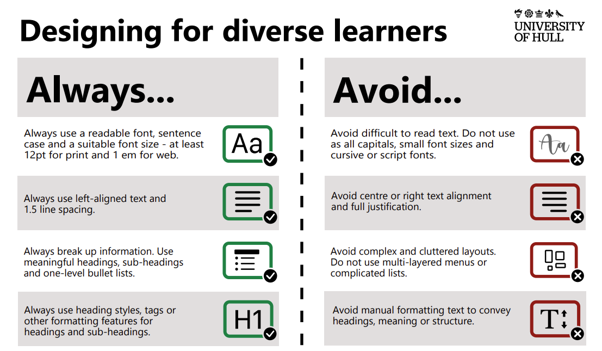
Learn more at https://designingfordiverselearners.info/
Ultimately, embracing inclusive design doesn’t require expensive software or specialist know-how—often, it’s just about making small, deliberate choices. It is a mindset — thinking accessibility and inclusion first. From adding alternative text to images in PowerPoint to structuring Word documents with proper headings, these changes can have a profound effect on accessibility. Once you start thinking about inclusive design, you find it permeates everything, from planning a lecture to setting up group activities or encouraging participation in seminars. The next step is to instill such practices within our students.
References
Abegglen, S., Burns, T., & Sinfield, S. (2023) Designing education: The role of learning design in higher education. London: Academic Press.
Equality Act (2010) Equality Act 2010, c.15. Available at: https://www.legislation.gov.uk/ukpga/2010/15/contents (Accessed: 4 February 2025).
Office for Students (OfS) (n.d.) Regulatory framework for higher education in England. Available at: https://www.officeforstudents.org.uk/ (Accessed: 4 February 2025).
Teaching Excellence Framework (TEF) (n.d.) Teaching Excellence Framework. Available at: https://www.tef.education.gov.uk/ (Accessed: 4 February 2025).
The Public Sector Bodies Accessibility Regulations (2018) The Public Sector Bodies (Websites and Mobile Applications) (No. 2) Accessibility Regulations 2018, SI 2018/952. Available at: https://www.legislation.gov.uk/uksi/2018/952/contents/made (Accessed: 4 February 2025).
Universal Design for Learning (UDL) (n.d.) Universal Design for Learning Guidelines. Available at: https://udlguidelines.cast.org/ (Accessed: 4 February 2025).
Web Content Accessibility Guidelines (WCAG) (n.d.) Web Content Accessibility Guidelines (WCAG) 2.1. Available at: https://www.w3.org/TR/WCAG21/ (Accessed: 4 February 2025).
Biographies

Lee Fallin, University of Hull
Lee Fallin is a Lecturer in Education Studies at the University of Hull. His research focuses on the intersections between education and geography, inclusive of physical and digital spaces. His current research interests include learning spaces and communities, inclusive digital practice, research methodologies and geographies of place.

Thomas Tomlinson, University of Hull
Tom Tomlinson works as an Educational Developer at the University of Hull. Tom develops and promotes excellent teaching. Tom has a background in design and explores the practical application of technology to enhance learning.

Gemma Spencer, University of Central Lancashire
Gemma Spencer is a Registered Nurse and Lecturer in Pre-Registration Nursing at the University of Central Lancashire and holds Fellowship status with Advance HE. Gemma is passionate about using innovative and creative techniques to support accessible and inclusive education for all. Connect with Gemma on LinkedIn.
Acknowledgements
Thank you to the LTHEchat organisers for inviting us to chat, and in particular, thanks to Jorge Freire, who provided valuable feedback. We hope Grammarly has helped us quash the typos, and we would also like to share thanks to our wider D4DL team for their work on the project and comments on this article: Ellie Davison, Kate Wright and Gemma Spencer.


 #LTHEchat
Pingback: Crynodeb Wythnosol o Adnoddau – 10/2/2025 |
Pingback: Weekly Resource Roundup – 10/2/2025 |
Pingback: Hosting #LTHEchat 318: Designing for Diverse Learners - Dr Lee Fallin