
Led by Liz Cable @lizcable.bsky.social
There are a lot of terms associated with the use of games in learning, teaching and assessment. We’ve had previous #LTHEchats tagged game-based learning, gamification, ludic pedagogy, playful learning, serious games and role-playing. I believe we don’t talk enough about analogue game-based learning (GBL), which is a peculiarly frustrating study as the term GBL in the literature usually assumes a digital game, rather than a physical one. It’s also often confused with gamification.
Gamification is the use of mechanics found in games for the purpose of learning. This could include earning stars for your nametag as a server at McDonalds or earning a “Top Fan” badge for participation in your favourite Facebook group. Badges can be useful for scaffolding learning, and leaderboards can be motivating for students and help them benchmark their progress, but these features of gamification do not make the learning experience itself into a game . Perhaps a term like “ludification” might better express the design aims of game-based learning which are to make the experience as game-like as possible. This means designing for fun, as well as for the player autonomy that comes from a clear set of rules and sufficient world-building to define the structure and boundaries of the learning experience.
The circumstances of a successful tabletop game, whether role-playing, cooperative board game, team challenge, pub quiz, escape game, or megagame are exactly the circumstances that we design for in an interactive classroom; participants who don’t necessarily know each other working together by combining their skills and knowledge, with a clear mission to complete, an expectation of fun and probability of success, whilst practising their social and soft skills as a by-product of these circumstances. They share the materials, ask questions, listen to each other, piece together the scenario then solve it, in whatever game format (or mix of formats) you have chosen to emulate. They share surprise, wonder, empathy, curiosity, challenge and success along the way – the aesthetics of a learning game in Hunicke’s (2004) Mechanics, Dynamics, and Aesthetics framework.
In this ideal scenario, players are left unperturbed by the personal exposition which is a feature of many “ice-breaker” style games (Cable, 2019), instead the materials of the game become the social objects (Engeström, 2005) around which the conversation is held: a piece of evidence in a police investigation, a character description of a resident in a flood scenario, a newsflash that gives a sense of urgency and geographically locates the problem on a map. Students can adopt the mantle of the expert (Heathcote & Herbert, 1985) and act “as if”, whether inside a scenario or co-creating one.
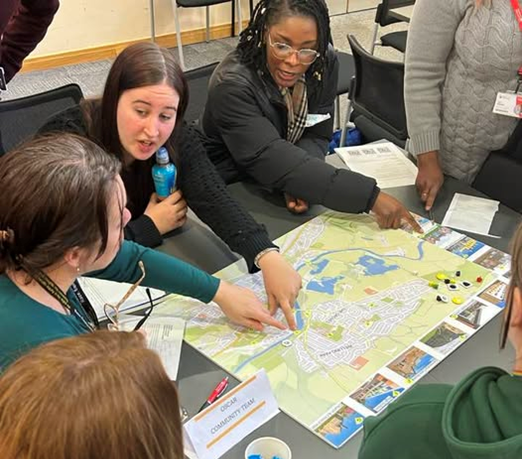
Scalability is an issue for classroom games. Commercial escape rooms usually have 6 players, board games are the same. In the classroom we need to scale up by duplicating the game enough times for the full class to participate, or by designing a game that makes a mechanism for players communicating between teams. Duplicating is the easiest solution, especially when you can have some digital elements – for example password-protected documents taking the place of physical padlocks – to make a hybrid game. Using the jigsaw classroom (Aronson, 1978), itself a useful technique for encouraging communication and movement, works well to move your students around stations in the classroom, the contents of each station will then contain an ergodic episode in your narrative.
Student attitudes can be a barrier. Undergraduates are at that crucial and contradictory age where they feel they need to put away childish things, so billing your activities as a game may not be your best marketing tactic. However, I defy you to find a student who hasn’t played Uno, or Exploding Kittens, or Cards Against Humanity… I could go on. Still, I find that inviting the students to play-test rather than play a game yields the best results. I ask them for their help in refining a game that’s in prototype, even when it’s been played a hundred times already. There is always room for improvement after all. I now design games that are deliberately broken; like controversy bait on social media, it encourages students to comment and correct, and in doing so, engage and learn.
Games should be designed to make students feel clever, curious and confident, even if that means making part or all of the game themselves. GBL offers a rich, engaging way to foster collaboration, creativity, and critical thinking, alongside the soft and social skills that have suffered. The article shares some key considerations for educators in the creation of game-based learning, including scalability, student attitudes, and design elements to ensure inclusivity and success, as well as the aesthetics – the feelings – provoked by the game, but we have more to learn.
Exploring GBL, sharing experiences, and collaborating on developing meaningful games for higher education is the way forward.
Useful notes
In January 2025 ORCID added a new set of work types for humanities research including teaching materials and by extension classroom games.
The Playful Learning Association is setting up a database of playful activities you can both use and contribute to.
If you have tabletop games of any kind to share, research or playtest with 40,000+ game enthusiasts, consider coming along to the Academic Track at UK Games Expo this year. Drop me a line if you’d like to be involved.
Biography

Liz Cable is programme lead for Digital Marketing at Leeds Trinity University and an expert in creating large-scale games for learning, training and a lot of fun. She is a narrative designer specialising in bringing online games and worlds to life in escape room, LARP and other immersive real-life game formats.
She co-wrote “Unlocking the Potential of Puzzle-based Learning. Designing Escape Rooms and Games for the Classroom” for Corwin.
References
Aronson, E., Blaney, N., Stephan, C., Sikes, J., & Snapp, M. (1978). The jigsaw classroom. Sage.
Cable, L. (2019). Playful interludes. In N. Whitton & A. Moseley (Eds.), Playful learning (pp. 57–70). Routledge.
Engeström, J. (2005, April 13). Why some social network services work and others don’t — Or: The case for object-centered sociality. Zengestrom. https://web.archive.org/web/20050413200624/http://www.zengestrom.com/blog/2005/04/why_some_social.html
Heathcote, D., & Herbert, P. (1985). A drama of learning: Mantle of the expert. Theory into Practice, 24(3), 173–180. https://doi.org/10.1080/00405848509543169
Hunicke, R., LeBlanc, M., & Zubek, R. (2004). MDA: A formal approach to game design and game research. In Proceedings of the AAAI Workshop on Challenges in Game AI (pp. 1–5). https://users.cs.northwestern.edu/~hunicke/pubs/MDA.pdf


 #LTHEchat