
Led by Jonatan Berhane @jonatanberhane.bsky.social and Nicole Blythe @njblythe18.bsky.social

Introduction
Podcasting has been widely adopted as a teaching tool in nursing and midwifery education, particularly in countries with the technological infrastructure to support it. Educators have used it to enhance traditional lectures by delivering teaching materials through audio-visual content (Strickland et al., 2012). Kemp et al. (2011) also found podcasting to be a valuable assessment tool, improving student engagement and oral communication skills.
Despite its growing use in healthcare education, podcasting remains underutilised as an assessment method—particularly in professional and vocational training, such as within the Nursing Associate programme in England and Wales (Blythe, 2024).
Recognising its potential benefits, we began exploring alternative assessment methods that could offer a fresh approach to learning while addressing emerging challenges—particularly the so-called “threat of AI.” Initially, AI felt like something out of RoboCop, but as we delved deeper, we realised it wasn’t an enemy to learning but rather a tool that students could use to enhance their podcast production.
This blog post offers a glimpse into our ongoing journey with embedding podcasting in the curriculum—our implementation strategies, the challenges we’ve tackled, and how we ensure its effectiveness as a learning tool for our diverse student population.
It’s important to highlight that when we talk about podcasting, we mean the face-to-face, collaborative process of producing a podcast, not the recordings themselves; we want engagement, discussion, and the dynamic exchange of ideas. While we don’t assess the collaborative aspect directly (we mark the individual), our pedagogy is designed to emphasise and foster collaboration throughout the learning process.
The rationale: Why Podcasting?
We firmly believe that assessments should be a learning opportunity for students, not just a means to measure performance. Our approach focuses on assessing to learn, not teaching to assess!
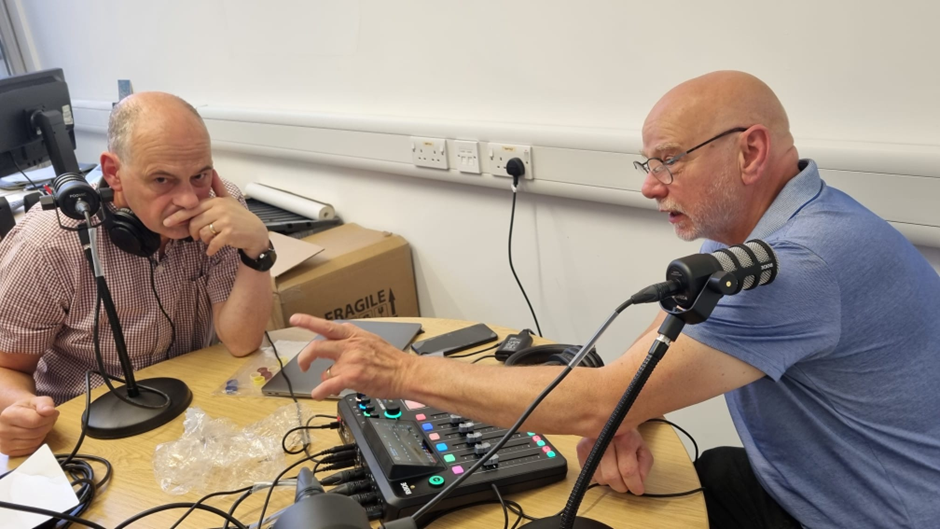
It all started with a vision but no clear path—our ideas were chaotic, our heads spinning in overdrive. Podcasting intrigued us as a way to help student nursing associates build communication and critical thinking skills while preparing them for the digital era. Desperate for guidance, we searched the University for anyone who could help, leading to an email to Adam Fowler (see picture below). After watching his insightful talk on podcasting in pedagogy, we reached out — unaware that this simple email would transform our whirlwind of ideas into reality.
Moore (2022) highlights the role of podcasting in pedagogy as a meaningful tool in decolonising the curriculum, making learning more relevant and accessible to a diverse student body. This perspective is particularly applicable to our students in Salford, where a wide range of cultural backgrounds shape learning experiences.
While traditional assessments such as essays and academic writing remain valuable, podcasting offers an alternative approach that some students may find more relatable—particularly those who are more comfortable expressing their ideas through spoken communication. The result is a more equitable learning environment that accommodates diverse learning needs, fostering skills such as teamwork and active listening (Powell & Robson, 2013).
Interestingly, Kay (2012) highlights how podcasting allows the students to enhance their critical analysis. For our students, this process involves not only researching the topic (in our case, long-term conditions), but also creating a tailored podcast resource designed to be easily understood by potential service users or patients.
Implementation: How Do We Use Podcasting?
We started by embedding podcasting in face-to-face seminars of no more than 30 students, allowing us to test the logistics and gather student feedback. While getting used to the technology, we also had to familiarise ourselves with the pedagogical approach, ensuring students had a meaningful learning experience rather than a chaotic trial-and-error process. To make life easier, we used existing lecture materials and developed a standardised structure that could be adapted to different themes and topics.
A typical structure includes:
- an introduction to podcasting,
- assigning research topics and
- allocating 90 minutes for group work.
Clear instructions are provided on using high-quality sources and incorporating different viewpoints to enhance critical analysis. Students also receive a structured crib sheet to guide their recording. This standardised approach, supported by scaffolding activities throughout the module, culminates in a summative group podcast assessment.
The summary below shows how podcasting has been embedded into my teaching and learning module so far.
- The “Skin Deep” Podcast – creating a resource exploring Psoriasis and its effect on body image and the benefit of a holistic nursing approach.
- The “Stress Reduction Toolkit” Podcast – aimed at creating a resource towards a patient suffering from chronic stress and possible exploration of techniques to manage this.
- “A Day In Court” Podcast – creating a podcast episode exploring NMC misconduct cases while bringing in relevant nursing evidence to fuel the critical discussion.
- “The End of Programme” Podcast – creating a podcast highlighting student voices and their experiences at the end of the 2 years’ Uni journey.
- Group Podcast – Assessment officially embedded in November 2025.
We have found that podcasting has many potential benefits, but there are some pitfalls to be aware of. Here is a summary of both.
Opportunities
- Authentic Assessment Methods – Using alternative assessments like OSCEs and simulated clinical scenarios (incl. podcasts) provides a more accurate representation of students’ ability to apply theoretical knowledge in real-world clinical settings.
- Podcasting for Collaboration and Engagement – Group podcasting fosters teamwork, communication skills, and digital literacy while allowing students to critically engage with content in an interactive and accessible format.
- Inclusive and Equitable Assessment – Offering diverse assessment methods, such as podcasting may accommodate neurodiverse students and those from non-traditional educational backgrounds, ensuring a fairer evaluation of competencies.
- Integration of Digital Tools in Education – Digital literacy is essential in modern healthcare, and incorporating digital tools in assessments prepares students for managing electronic records, telehealth, and other technology-driven aspects of care.

Barriers
- Resistance to Change – Shifting from conventional to more contemporary assessment methods may face institutional and faculty resistance, requiring cultural and structural changes in nursing associate/nursing education.
- Risk of Over-Reliance on Technology – While digital tools are essential, excessive dependence on them may reduce face-to-face patient interaction, potentially compromising holistic and human-centred care.
- Ethical and Privacy Concerns – The use of digital platforms in assessments raises issues of data security, informed consent, and the responsible handling of sensitive patient information.
- Uncertainty Around the Longevity and Authenticity of Podcasting – While podcasting offers an innovative and engaging assessment method, questions remain about its ability to authentically evaluate clinical competencies. There is also debate over whether podcasting is a lasting and valuable tool in education or merely a passing trend, raising concerns about its long-term relevance in nursing associate/nursing assessment.
Conclusion
Podcasting offers an innovative, inclusive assessment approach, promoting collaboration, digital literacy, and critical thinking. However, for it to be successful, assessments must be carefully designed to ensure students are learning through the process, not just being measured. This shift, while overcoming challenges, promotes equity and inclusion, better preparing students for contemporary professional environments much beyond the realms of nursing.
Authors’ biographies

Jonatan Berhane
Jonatan Berhane is a Clinical Educator and Module Lead for the Nursing Associate Programme at the University of Salford. His Module focuses on long-term conditions across the life span and across all fields of nursing practices. With a wealth of experience in surgical nursing, particularly in Theatres, Jonatan is deeply passionate about creating learning experiences that reflect the diverse student population he encounters at Salford.
Since joining Salford in 2023, Jonatan has been a finalist for several local, regional and national awards, including: 2025 MIMA, 2025 UoS Apprenticeship Awards, and the upcoming 2025 Student Nursing Times Award where he is hoping to win in the Educator of the Year category for his innovative use of podcasting in education.
Social Media:
Bluesky: @jonatanberhane.bsky.social
LinkedIn: Jonatan Berhane
X: @UniOSalfordTNA (Programme Account)

Nicole Blythe
Nicole leads an award-winning, multiple award-nominated programme at the University of Salford, where the Nursing Associate Course has become one of the most popular in the North of England.
She began her nursing career in 1989 in Erlenbach am Main, Germany, before relocating to the UK in 1997. With over three decades of experience in acute medical and cardiology nursing, Nicole transitioned into higher education in 2018. Now a key figure in Nursing Associate education, she is passionate about empowering students through education—especially those who may not have had a voice—to gain confidence and challenge paradigms.
Social Media:
Bluesky: @njblythe18.bsky.socialz
LinkedIn: linkedin.com/in/nicole-blythe-53a951335
X: @NJBlythe18
X: @UniOSalfordTNA (Programme Account)
Reference List
Blythe, N. J. (2024, November 14). I often find myself questioning traditional methods of student assessment. Nursing Times. Retrieved from https://www.nursingtimes.net/education-and-training/i-often-find-myself-questioning-traditional-methods-of-student-assessment-14-11-2024/
Kay, R. H. (2012). Exploring the use of video podcasts in education: A comprehensive review of the literature. Computers in Human Behavior, 28(3), 820-831. https://doi.org/10.1016/j.chb.2012.01.011
Kemp, J., Mellor, A., Kotter, R., & Oesthoek, J. (2012). Student-produced podcasts as an assessment tool: An example from geomorphology. Journal of Geography in Higher Education, 34(2), 117-130.
Lin, C. C., Wu, S., & Dumalina, L. (2024). Podcasting across borders: Navigating and negotiating culturally responsive practice in virtual exchange. NYS TESOL Journal, 11(1).
Powell, L., & Robson, F. (2013). Learner-generated podcasts: A useful approach to assessment? Innovation in Education and Teaching International, 51(3), 326-337. https://doi.org/10.1080/14703297.2013.796710
Strickland, K., Gray, C., & Hill, G. (2012). The use of podcasts to enhance research-teaching linkages in undergraduate nursing students. Nurse Education in Practice, 12(4), 210–214.


 #LTHEchat