
Led by Professor Leanne de Main, Pro-Vice Chancellor – Pedagogic Transformation, Interim Dean – Faculty of Business and Law, De Montfort University @professor-c.bsky.social
From 2022, De Montfort University (DMU) embarked on a new education strategy becoming the first university in the UK to transform over 90% of its undergraduate and postgraduate curriculum to a Block mode of scheduling and learning.
What is Block?
Block design sees students studying one subject at a time, completing the module and all assessment by the end of the Block. This model contrasts with traditional models in which students study several modules at a time with varying assessment submission points, often culminating in several end-of-year assessments within a short time frame.
At DMU, students study one 30 credit module in each seven-week block. Timetabled teaching occurs in weeks one to six with the seventh week being reserved as assessment submission week. See Figure 1 below for an overview of a regular Block scheduled undergraduate programme. The slight difference for postgraduate students is that they continue into Block five and six to complete a final project or dissertation.
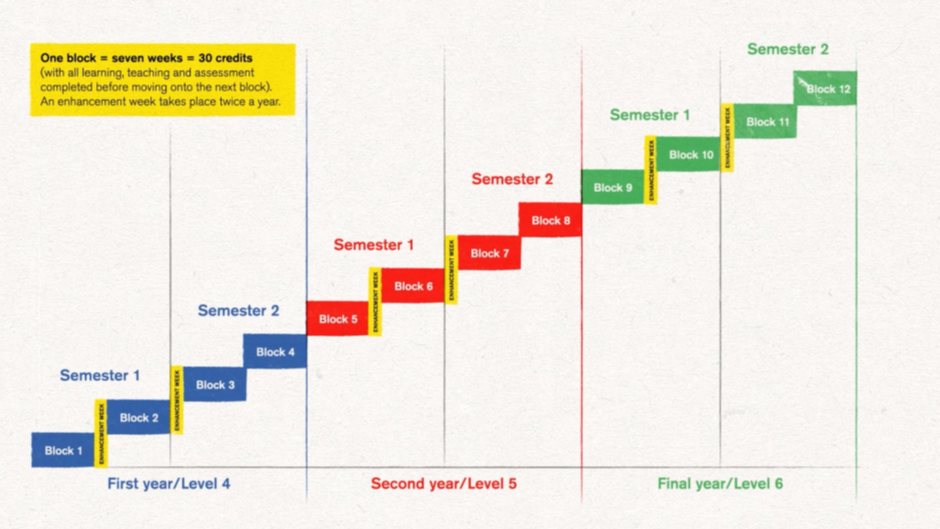
Fig 1. Block Learning at De Montfort University (Undergraduate)
Why Block?
Whilst DMU might be the first in the UK to move to Block learning at an institutional level, there are several examples of the Block model over decades at varying levels of adoption. There are also several examples of whole institutional transitions outside of the UK. Colorado College, US, introduced The Block Plan over 50 years ago, and Victoria University, Australia, launched the VU Block Model® several years before DMU’s launch. The Block community is incredibly collaborative, at DMU we received guidance and support from several Block pioneers, including Victoria University, Southern Cross University (The Southern Cross Model) and the University of Suffolk (Block and Blend).
Our journey to Block explored the impact of Block learning through the research and experiences of others, whilst understanding the complexity of our students and the varying challenges they may face in Higher Education. Our key aims for the transition were to enhance student satisfaction and create an environment where more students were retained and progressed in their studies.
Buck and Tyrell (2022) found that Block teaching had a positive impact on student confidence, time management, learning, achievement and concentration. Immersive scheduling, such as Block, when combined with an active, guided pedagogy can enhance student achievement and satisfaction (Goode et. al. 2023).
Slevin (2021) identified that Block teaching was better able to accommodate the interrelated academic and wellbeing challenges that may students today experience. It also supports the development of more positive peer networks and supports feelings of community and belonging (Jones 2018), this was further evidenced by Turner et al. (2021) who found that cohorts bonded more quickly.
Like most universities, we find students declaring disabilities and neurodiversity has increased. Dixon and O’Gorman (2020) found Block to be particularly advantageous for neurodiverse learners and for those from diverse backgrounds. The consistency and stability that Block scheduling provides supports students more holistically (Meehan and Howells 2019). However, there has been some concern that students who may need to miss a week or two due to illness or disability may find it difficult to catch up with missed learning opportunities, this is a factor that needs consideration in designing learning activities.
Data from DMU’s internal student satisfaction surveys have certainly seen an increase in the satisfaction of teaching and learning. We have also seen in increase in student retention and first-pass rates across many of our programmes, an early indication that our initial aims are being met. A number of academics at DMU have engaged in evaluation and scholarly collaborative research to understand the impact of Block teaching further.
References
Buck, E. and Tyrrell, K. (2022) Block and Blend: A mixed methos investigation into the impact of a pilot block teaching and blended learning approach upon student outcomes and experience. Journal of Further and Higher Education, 46(8), 1078-1091.
Dixon, L., and O’Gorman, V. (2020) ‘Block teaching’ – exploring lecturers’ perceptions of intensive modes of delivery in the context of undergraduate education, Journal of Further and Higher Education, 44:5, 583-595.
Goode, E., Roche, T., Wilson, E., & McKenzie, J. W. (2023). Implications of immersive scheduling for student achievement and feedback. Studies in Higher Education, 48(7), 1123–1136.
Jones, S. (2017) “Disrupting the Narrative: Immersive Journalism in Virtual Reality.” Journal of Media Practice 18 (2–3): 171–185.
Meehan, C. and Howells, K. (2019) In search of the feeling of ‘belonging’ in higher education: undergraduate students transition into higher education, Journal of Further and Higher Education, 43:10, 1376-1390.
Slevin, T. (2021). Block Teaching in Art and Design: Pedagogy and the Student Experience. Art, Design & Communication in Higher Education, 20(2), 163-183.
Turner, R., Webb, O.J. and Cotton, D.R. (2021) ‘Introducing immersive scheduling in a UK university: Potential implications for student attainment’, Journal of Further and Higher Education, 45(10), pp.1371-1384.
Useful Links
Block Teaching at DMU: https://www.dmu.ac.uk/empowering-university/block-teaching/index.aspx
Our QAA Collaborative Enhancement Project: https://learninblock.dmu.ac.uk/
Our latest Advance HE Collaborative Development Project: https://www.advance-he.ac.uk/membership/collaborative-development-fund/2024-25/imagining-block-enacting-block-insights-design-and-delivery-educational-change
Join the Block Community on JISCMail https://www.jiscmail.ac.uk/cgi-bin/webadmin?A0=LEARNINBLOCK
Times Higher Education articles from educators all collated in one place https://www.timeshighereducation.com/campus/collections/what-block-teaching
Author Biography
Leanne is an experienced senior leader in Higher Education, currently as Professor of Education, Pro Vice-Chancellor and Interim Dean at De Montfort University. She is a Principal Fellow with Advance HE (PFHEA), holds the CMBE with the Chartered Association of Business Schools, is a member of the British Academy of Management (BAM), an Advance HE Aurora Mentor and an Associate Member of the Association of Learning Technology (ALT).
Leanne is a Peer Reviewer for the European Federation of Management Development (EFMD) supporting Business Schools globally in achieving EFMD accreditation. In January 2022, Leanne joined the Advisory Group for the QAA review of Business and Management Benchmark Statements and has recently completed two QAA funded Collaborative Enhancement Projects looking at student experience post-covid and Block Teaching. In January 2025, Leanne won funding from Advance HE and is collaborating with international universities on Block 2.0.
Leanne researches teaching and learning, neurodiverse learners, widening participation and opportunity in HE with a focus on curriculum design models, Block teaching and design sprint methodology: a strategic transformation she led as Associate PVC Education at DMU. Her TEF-focused book, ‘Achieving Teaching Excellence‘ was released in 2021. More recently, in January 2025, her chapter on ‘Quality in Block Teaching’ was published in ‘Block Teaching Essentials’.


 #LTHEchat