
This #LTHEChat took place on Bluesky on Wednesday 30th April 2025 at 2000 BST.
Led by Emeriti Professor Sally Brown @profsallybrown.bsky.social and Emeritus Professor Phil Race @philrace.bsky.social
We published the first edition of The Lecturer’s Toolkit with Routledge 1998 and there have been four further editions since, published by Phil alone. When we were asked to do a sixth edition for 2025, we had to recognise just how much has changed in the last five years. The intervening years witnessed the unprecedented changes that came about in teaching, learning assessment following the onset of the Covid pandemic and some amazing and challenging technological innovations that no Higher Educator can ignore. That’s the area we are covering in this blogpost and associated chat.
Looking back through the earlier editions, it’s amazing how many of the questions that occupied us nearly 30 years ago when we first started writing the book soon after we married remain today. These include: how do students learn? What part does assessment play in learning? How can feedback be made meaningful? What are lectures for? Why is small group learning important? How can those new to teaching in higher education look after ourselves? How can we make our teaching and learning support inclusive? At the heart of the first and every subsequent edition was what became known internationally as the “Race model of learning” that Phil had been propounding long before the book was written (if fact one of my first recollections of meeting Phil, was at one of his sessions on exactly this topic!)
But some things have moved away from current practice, at least in privileged nations. Rarely now in Higher Education do you see endless screeds of chalk on blackboards. Mastering the overhead projector was once an essential talent, now not so much. Hard copy handouts have mostly disappeared in financial cuts and students tend not to take endless handwritten notes in lectures (which were often ignored afterwards!) Phil’s favourite Post-its still can still be found in many a workshop exercises though!
New issues we addressed inter alia included:
- What has been the impact of the pandemic on face-to-face and online learning, especially the wider take up of digital tools to help students learning online?
- How can (or should) we respond to the ubiquity of large Language Models e.g. ChatGPT?
- How can we move towards greater authenticity in assessment and feedback practices?
- What’s to be done about the ’new digital divide’ which will separate wealthy institutions and students who can invest in ‘state-of-the-art’ GenAI facilities and support from the rest?
- How can we retain momentum in recognising the importance of Equality, Diversity and Inclusion issues in our live and virtual classrooms every day?
- With students spending less time on campus physically than previously how can we help students to actively engage with HEIs?
- How should both good and excellent practice in teaching, learning and assessment be recognised, valued and accredited?
We knew that in our semi-retired state we would need some help to check our currency and relevance to changing contexts, so we recruited eminent colleagues as chapter readers and advisors on innovations.
Michelle Morgan helped us navigate issues around the student experience and transition to make us think about how students really learn nowadays as well as advising us on diversity issues including the Uk University Mental Health charter;
Kay Sambell gave us both scholarly and practical advice on assessment and feedback issues:
Sue Beckingham helped us greatly to think about how lecturing, both live and virtual, has changed since the pandemic, and her advice with Peter Hartley on using Generative AI effectively in higher education was invaluable.
Mark Glynn supported our rewriting of the small group teaching chapter and also was tremendously helpful in shaping our thinking about good and poor academic conduct.
Our final chapter looking at future trends benefitted from guidance from all of the above plus Steve McHanwell and Marita Grimwood on evidencing teaching achievements, with Belinda Cooke making sure we were up to date on the Advance HE Fellowships scheme and similarly Karen Hustler of Advance HE helping us with currency of the UK National Teaching Fellowship scheme. Pina Franco offered perspectives as a regular user with her PGCHE students of earlier editions of the book.
Everybody helped, including our invaluable editorial assistant Joe Penketh, who as the most recent student among us helped with common sense perspectives and the occasional media-related apercu!
In the chat that follows, we hope to hear both your thoughts on what has changed as well as what has stayed much the same, alongside your ideas about where HE teaching, learning and assessment is going in the future.
You can find the book here:
https://www.routledge.com/The-Lecturers-Toolkit-A-Practical-Guide-to-Assessment-Learning-and-T/Brown-Race/p/book/9781032738345
Author Bios
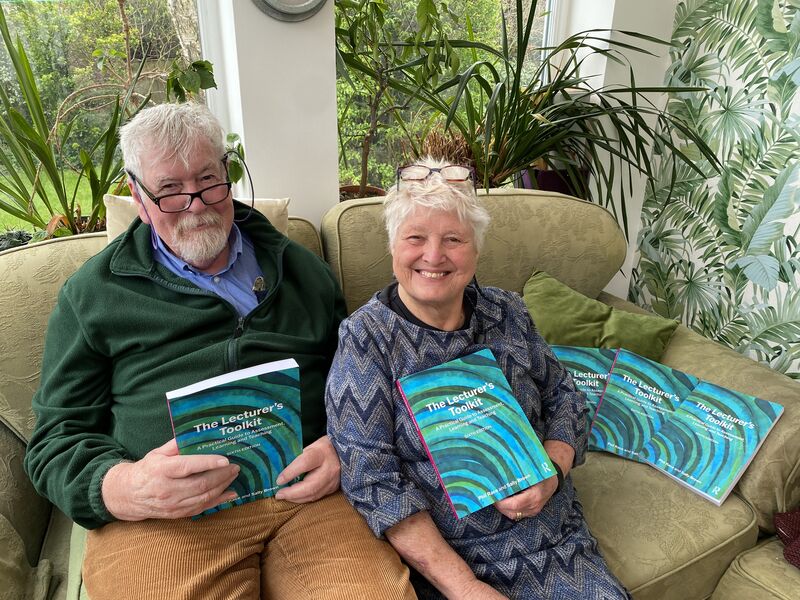
Phil Race and Sally Brown are long established, semi retired learning and teaching aficionados with a great track record of publications and workshops.
Both have visiting professorships at Edgehill University and a panoply of earlier visiting professorships and honorary doctorates to their names, as well as being Emeritus/Emerita professors at Leeds Beckett University. Phil is probably best known for his pragmatic model of learning, now known as the Race model of learning. Sally nowadays is best known for her work on assessment and feedback but in earlier times worked on creative problem-solving and leadership. She has also mentored dozens of colleagues over the years Between them they have the best part of 100 books they have written, co written, edited or co-edited if you count all the foreign translations and subsequent editions . This blog is part of their celebrations of the publication of their last book, the sixth edition of the Lecturer’s Toolkit.
Questions and chat
- Q1 What are the key aspects of teaching, learning and assessment that have continued to be non-negotiable for you? (split over two posts)
- Q2 What do you think have been the biggest gains in the teaching and learning experience for students in the last five years (and the previous 25)?
- Q3 What important aspects have been lost, ignored, wilfully dropped or omitted?
- Q4 How in your country has the profile of the student cohort changed over the duration of your HE teaching career?
- Q5 Given a mythical magic wand, what major change would you gift to universities of the future and their students?
- Q6: We won’t be writing a seventh edition in 2030, but if we were to, what do you foresee will be the biggest issues on the horizon in half a decade’s time?


 #LTHEchat