
This #LTHEChat took place on Bluesky on Wednesday 21st May 2025 at 2000 BST
Led by Kelly Trivedy, Independent Academic Enhancement Consultant for Pedagogic Development and Academic Skills in HE and FE. @kellytrivedy.bsky.social

We live in a world where critical thinking is more important than ever. Globally, the World Economic Forum (2025) has stated that analytical skills are the number one skill required. On an academic level, research commissioned by HEFCE found that, among other related skills, students’ aptitude to think critically was a contributing factor to post-university success (Zahner, 2018).
If you take a moment and think about:
- What was your experience with critical thinking when you first started higher education?
- Did you ever question why certain ideas were presented as unquestionable?
- Did you find yourself agreeing silently, even though the material didn’t quite resonate with you?
Keep your answers to these questions in mind as you read through the remainder of this article.
What is critical thinking?
Within the context of HE, critical thinking has been a focal point for many years. Dewey (2012) talked about it in the context of having good thinking habits. But if we rewind further, we can see its philosophical roots that date back to the time of Socrates and Plato.
It is regularly the ”buzzword” (Fisher, 2011, p.1) given to the method that involves thinking by competently exercising control of the “structures inherent in thinking and imposing intellectual standards upon them” (Paul and Elder, 2010). What I’ve found, however, is that it often gets reduced to checking for bias in sources or debating opposing views. We are reminded by bell hooks that “thinking is an action” (hooks, 2010, p.7). Taking on the view of hooks, I believe that thinking critically may provide discomfort, a chance to reflect, and ultimately lead to transformation.
But for this to happen, we need to equip ourselves with the tools that help us think critically, regardless of where we are in our personal, professional, and academic journeys.
Throughout my earlier research for my MA in Education on critical thinking, I noticed that almost every paper I read started with a similar statement: “there is no singular shared definition of critical thinking.” I see this lack of a uniform definition as both a blessing and a curse. It’s a blessing because it allows for nuanced application across various disciplines. However, it can be a curse if educators, students, and colleagues in the education sector do not have a shared understanding of what critical thinking means.
I prefer this definition as it really provides focus of the process as opposed to product: “everything to do with how we think,” vs “what we think” (Mulnix, 2012).
My story and experience with critical thinking
My work in critical thinking began (years ago) during my PGCE course when I was involved in developing a new Bachelor’s degree program in criminal justice alongside my mentor. We had the freedom to design the entire course ourselves. Early on, I noticed that the students enrolled in the program struggled with critical thinking; they tended to accept everything they read without question. This raised alarm bells for me, and I decided to create my first critical thinking skills program. For the first 30 minutes of each session throughout the year, we focused on developing critical thinking skills.
After graduating from the PGCE course, the importance of critical thinking continued to occupy my mind, and I felt that my work on the PGCE was just beginning. I secured my first role as a skills specialist, where I worked to advocate for the significance of critical thinking through tailored programs that supported both educators and students. I have incorporated critical thinking methods in my lecturing, developed subject-specific programs, led general workshops as a coach, and am currently consulting with higher education and further education departments nationwide to address critical thinking in curriculum redesign, continuing professional development, and student development initiatives.
Why does critical thinking matter?
Critical thinking impacts all of us at different stages of our lives. We rely on it more than we might realise! If we consider everyday life and decision-making regarding the most mundane things, such as buying a plastic-free water bottle, we research materials, size, properties, and price points. This is critical thinking.
It engages us in developing our own intellectual autonomy and exercising it when we need to draw upon it. University study enhances knowledge of a subject, but hopefully, it also provides the skillset to question that knowledge and understand how it is constructed.
Critical thinking also encourages us to think beyond our subjects, and I believe it is a transferable skill; it can be adapted, nurtured, and applied across various disciplines.
Ultimately, I would argue that at its core, critical thinking gives society the best chance for honest and compassionate debates. If exercised purposefully, it can lead us to be more empathetic with views different to our own.
Higher education aims to transform how students think, question, and engage with the world and across the sector, with critical thinkingcentral to this mission. However, this transformation won’t occur by accident. It requires intentional design, reflective pedagogy, and a commitment to fostering environments where students can challenge assumptions, particularly their own.
In my work (broadly speaking), these are the steps I follow to help both students and educators achieve this:
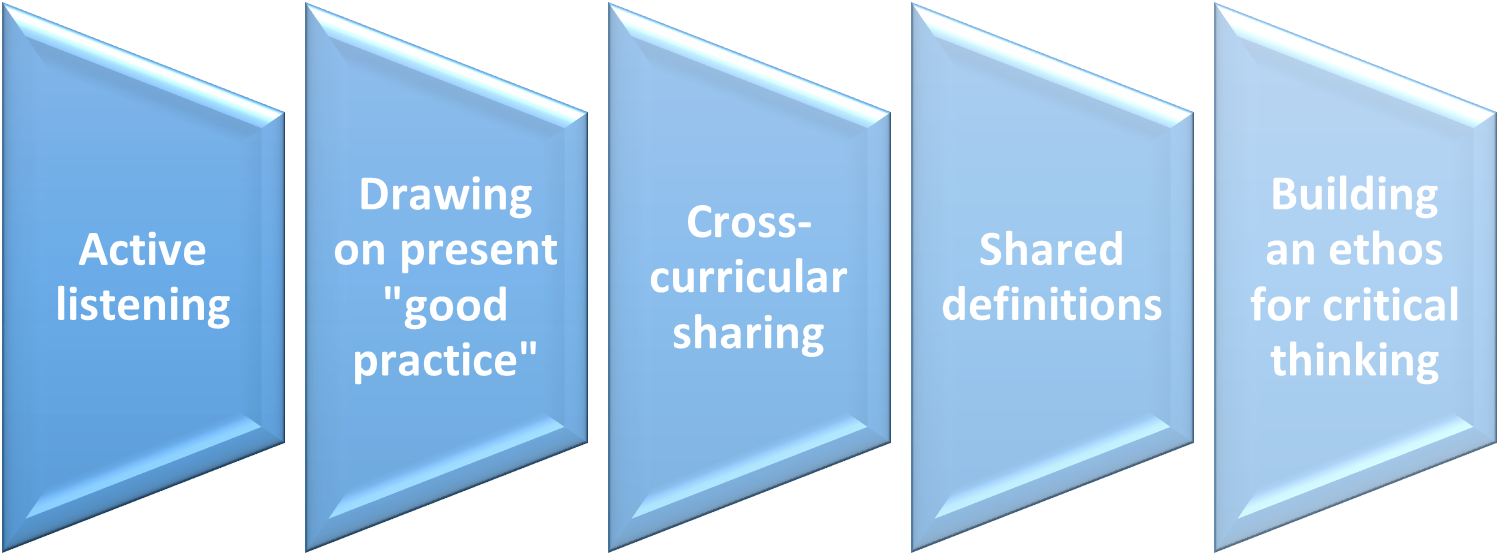
In a society filled with misinformation, polarisation, and change, I believe universities have an ethical responsibility and intellectual ability to equip students with the tools to facilitate their critical thinking skills.
Those of you who strive to include critical thinking as part of your practice, do let me know how it’s going. I am always open to a conversation about critical thinking. We are all in it together to help and support the next generation of critical thinkers. As bell hooks (2010, p.11) articulates, “…it calls for initiative from everyone…”
Reflecting on the earlier questions in this article, here is a new set of reflective questions to help to re-frame how we may approach critical thinking:
- How would you help others to enhance their experience of critical thinking in education?
- How can you and others around you question ideas with curiosity?
- How can you support those around you to feel comfortable in speaking out, even if their ideas don’t completely align with your own?
Since creating my podcast, Talking CriticalEd in 2024, and my Substack, ‘The Critical Thinking Loop’ in 2024, I’ve had many positive responses, and I hope to continue my work spreading the word and enhancing how we frame critical thinking.
References
Dewey, J., 2012. How We Think. United States of America: Martino Publishing.
Fisher, A., 2011. Critical Thinking: An Introduction. 2nd ed. Cambridge: Cambridge University Press.
Hooks, B., 2010. Teaching Critical Thinking: Practical Wisdom. London. Routledge.
Mulnix, J.M., 2012. Thinking Critically about Critical Thinking, Educational Philosophy and Theory [online], (44) 5, 464-479.
Paul and Elder, 2010. Paul-Elder Critical Thinking Framework [online]. Louisville: Delphi Center. Available at: https://louisville.edu/ideastoaction/about/criticalthinking/framework [Accessed 10 May 2025].
World Economic Forum, 2025. Future of Jobs Report 2025: Insight Report January 2025 [online]. Available at: https://reports.weforum.org/docs/WEF_Future_of_Jobs_Report_2025.pdf [Accessed 1 May 2025].
Zahner, 2018. Critical thinking skills: Essential for the future [online]. HEFCE. Available at: https://webarchive.nationalarchives.gov.uk/20180319124644/http://blog.hefce.ac.uk/2018/02/28/critical-thinking-skills/ [Accessed 1 May 2025].
Author Biography

Kelly Trivedy is an Independent Academic Consultant specialising in pedagogic and skills development with a focus on critical thinking, research skills and reflective practice. Her career spans roles in lecturing, academic development, consulting and coaching. She is the author of ‘Plan your Research Project’, ‘The Critical Thinking Loop’ Substack and host of the Talking CriticalEd podcast. Kelly has also contributed to blogs, podcasts and book chapters across the HE sector. You can find more about Kelly and her work on her website.
Questions and chat
- Q1 What does ‘critical thinking’ mean to you?
- Q2 What challenges have you observed learners facing regarding critical thinking?
- Q3 What impact does or will AI have on critical thinking, and are there any changes or adaptations needed? What might these look like?
- Q4 What role can learners play in their critical thinking journey, and how can educators, developers, and other education professionals facilitate this process?
- Q5 In what way is critical thinking given importance in your subject? And why do you think it should be given that value? Please share your discipline in your answer.
- Q6 If you could summon a genie, what would be your three wishes for re-designing critical thinking in education? How would it look, and what actions would you take to make it happen?


 #LTHEchat