#LTHEChat 263 Escape Rooms for Challenge-based learning led by Clare Thomson @slowtech2000, Deb Baff @debbaff, Coral Condeco-Dunachie @CDunachie and Rosemarie McIlwhan @RMc_LT

A mug with the text 'escape the ordinary' with an arrow pointing right underneath. The mug is situated on the edge of a table with water in the background which reflects trees.
Escape the ordinary

Escaping the ordinary; Escape Rooms for Challenge-based Learning 

Popular television shows in the UK in the 1980s and 1990s, such as The Adventure Game and The Crystal Maze, saw participants locked in futuristic locations where they were required to solve different puzzles to win prizes. Globally, this concept of a physical escape room began to emerge as entertainment in many other forms during the early 2000s, stemming from the USA and Japan (Nicholson, 2015). The overall premise is that a team of players work cooperatively to find the solutions to different puzzles to solve a code or find a key to ultimately escape the room within a specific time frame.

In recent years educators have employed escape rooms physically on campus, and online with the additional benefits of flexibility and scale as well as providing the option of being available to students synchronously or asynchronously (Fotaris and Mastoras, 2019; Lathwesen and Belova, 2021; Makri, Vlachopoulos and Martina, 2021; Taraldsen et al., 2022). These include discipline specific escape rooms as well as interdisciplinary projects, addressing wider academic skills such as digital/information literacies, through to staff development and conference activities.

Regardless of the situation, the collaborative nature of escape can encourage teamwork, critical thinking, problem-solving, communication skills and more in a fun environment. However, as with other game-based activities careful thought has to be given to the design and implementation of the room. For example, the level of challenge needs to be carefully balanced, to avoid being overly easy or frustratingly difficult to maintain engagement and interest throughout.

This chat is a precursor to an event hosted by the Learning and Teaching Academy, Heriot-Watt University, on Friday, 9th June 2023 – Escape Rooms in Education: Showcase and Celebration. This lead-up discussion is a chance for the #LTHEchat community to share their practice with and explore the use of escape rooms in learning and teaching.

Fotaris, P. and Mastoras, T. (2019) ‘Escape Rooms for Learning: A Systematic Review’, in Proceedings of the 12th European Conference on Game Based Learning. 2th European Conference on Game Based Learning, ACPI, p. 30. Available at: https://doi.org/10.34190/GBL.19.179.

Lathwesen, C. and Belova, N. (2021) ‘Escape Rooms in STEM Teaching and Learning—Prospective Field or Declining Trend? A Literature Review’, Education Sciences, 11(6), p. 308. Available at: https://doi.org/10.3390/educsci11060308.

Makri, A., Vlachopoulos, D. and Martina, R.A. (2021) ‘Digital Escape Rooms as Innovative Pedagogical Tools in Education: A Systematic Literature Review’, Sustainability, 13(8), p. 4587. Available at: https://doi.org/10.3390/su13084587.

Nicholson, S. (2015) Peeking behind the locked door: A survey of escape room facilities. White Paper. Available at: http://scottnicholson.com/pubs/erfacwhite.pdf (Accessed: 4 May 2023).

Taraldsen, L.H. et al. (2022) ‘A review on use of escape rooms in education – touching the void’, Education Inquiry, 13(2), pp. 169–184. Available at: https://doi.org/10.1080/20004508.2020.1860284.

Guest Bios

Clare Thomson, a white woman with blond hair and waering glasses is facing forward and smiling
Clare Thomson

Clare Thomson is an Assistant Professor of Digital Pedagogies & Course Design at Heriot-Watt University. Clare has worked in higher education for over sixteen years and within the field of education technology for over twenty years. She a PhD student at the University of Edinburgh researching reflective practice in medical education. Her interests focus on reflection, inclusion, digital accessibility, creativity and care. Clare is co-chair of the Association of Learning Technology (ALT) Northern Ireland members group, a Senior Fellow of AdvanceHE (SFHEA), Certified Member of ALT (CMALT) and AdvanceHE Collaborative Award for Teaching Excellence (CATE) 2022

Deb Baff, a white woman with blond hair has her head tilted slightly to one side and is smiling at the camera.
Deb Baff

Debbie Baff is a Subject Specialist (Leadership and Culture) focusing on the Digital Leaders Programme at Jisc and has over 25 years experience of working in Higher Education & the voluntary sector. An Open Educational Practitioner and PhD Student in E Research and TEL. Her research interests are in online social support and the impact on wellbeing for educators. She is co-chair of the Open Education Special Interest  Group and contributes to several committees and groups at the Association for Learning Technology. An open digital badge enthusiast and keen sketchnoter, Debbie has a creative approach to learning, teaching and building communities both online and in person. Debbie is a Fellow of Advance HE (FHEA) and a Certified Online Learning Facilitator (COLF) and a member of the Research in Learning Technology and the Journal of Social Media for Learning Editorial Board.

Coral, a white woman with long dark hair is wearing a white top with black spots and is smiling at the camera.
Coral Condeco-Dunachie

Coral is a Learning Technologist and Design Specialist who has worked in higher education for ten years, specialising in supporting organisations to develop their Technology Enhanced Learning practices. She recently completed her Masters in Online and Distance Education, with a focus on accessibility and use of AI technologies. Her expertise includes instructional design and the integration of technology to enhance the learning experience.   

Rosemarie, a white woman with long brown hair smiles at the camera.
Rosemarie McIlwhan

Rosemarie McIlwhan is an Associate Professor of Digital Pedagogies and Practices, at Heriot-Watt University. She leads on digital pedagogy across the global university and is also the Programme Director of the Postgraduate Certificate in Teaching and Learning. Rosemarie has an inter-disciplinary background encompassing law, education and development management. She has been teaching and researching in higher education for over 20 years, with a particular focus on equity, open and digital education and widening participation. Rosemarie is a member of the Research in Learning Technology Journal Editorial Board, co-host of the FutureTeacher webinar series and a Senior Fellow of AdvanceHE (SFHEA). 

Missed the chat?

No problem, here’s a curated collection of the tweets so you can review and participate at a time that suits you.


Posted in announcement | Tagged , , , , | Leave a comment

#LTHEchat 262 Phenomenon-Based Learning led by Dr Kate Cuthbert @cuthbert_kate, Sue Lee @SueLee99 and Emily Chapman-Waterhouse @cwaterhouse_e

Graphic of a human head with phenomena like stars and rainbows jumbled together and bursting out.

How do we harness the phenomenal?

We are working on a project exploring the possibilities of using Phenomenon-based learning in higher education (PHBL). In PHBL, learning is provoked and guided by given events or occurrence. The selected phenomenon is a constant for the students as they progress through a cyclical enquiry process of engage, explore, expand and execute. The phenomenon plants itself within all learning activities providing a place and justification for discipline knowledge.

As a team we have experienced many a furrowed brow trying to conceptualise this approach to learning, how it might be differentiated with other more well-known approaches and what it might look like to different students and different educators. How might it positively disrupt module constraints? How could it be effectively employed to offer impactful interdisciplinary learning? What is the place of content/ knowledge? Is it best for a student to engage with content and theory before, during or after the applied context? So, it isn’t without irony when we say that our PHBL project has mirrored inquiry-based learning by producing more questions than answers! But what we have been struck with is how PHBL has triggered students to appreciate and apply their discipline knowledge to real world issues. 

During 6 workshops students from a variety of discipline backgrounds, different stages in their study and at 2 contrasting universities gave us their take on PHBL. As part of the testing of PHBL, our students interacted with phenomenon such as AI in Healthcare, Food Sustainability and High-Speed Rail developments. All of these phenomenon were introduced with a “What if” proposition….

  • What if your next GP appointment was led by a robot? 
  • What if all food consumed had to be produced within a 500-mile radius?
  • What if a community had to be relocated as part of the HS2 development?

You can imagine that a multidisciplinary group engaged with these phenomena in very diverse ways. The students generated their own lines of enquiry which represented their course experience and learning needs. Importantly though these lines of enquiry built up into a meta exploration of a phenomenon, where discipline boundaries were challenged, and discipline knowledge was contextualised. 

We are looking forward to hearing from the LTHEchat community about their experiences of using phenomena to trigger learning experiences.

Guest bios

A portrait photograph of Dr Kate Cuthbert

Dr Kate Cuthbert – Pedagogic Projects Development Manager in the Staffordshire Centre for Learning and Pedagogic Practice

A portrait photo of Sue Lee.

Sue Lee – Senior Research Fellow in the Staffordshire Centre for Learning and Pedagogic Practice

A photo of Emily Chapman-Waterhouse

Emily Chapman Waterhouse – Associate Head of Department (Veterinary Nursing) Harper Adams

Missed the chat? No worries, here is a link to the wakelet for #LTHEChat 262

Posted in announcement | Leave a comment

#LTHEchat 261 Active Learning, led by Mary Jacob @MaryJacobTEL1 and Dr Wendy Garnham @DrWGarnham

The logo consists of a roundel of four figures representing people waving, in different colours. Underneath is written 'Active Learning Network;.
Active learning Network Logo

For anyone involved in teaching and learning in Higher Education, you won’t fail to have witnessed the proliferation of research advocating the value of “active learning”. Not only has it been held responsible for eliminating gender achievement gaps in some subjects (e.g. Theobald et al., 2020) and helping students to feel more engaged with their studies (Chiu and Cheng, 2017) but it has also been considered instrumental in reducing mental health issues associated with university level study such as anxiety (Adkins-Jablonsky et al., 2021) as well as reducing stress around assessments (e.g. Khan and Madden, 2018).

Wendy’s personal journey with active learning

One of the positive consequences of this focus on active learning has been the increasing development and availability of new tools to aid learning. The Global Festival of Active Learning for example, is due to have its 3rd annual run later this month with an international collection of contributions showcasing active learning methodology. I won’t hesitate to say that I am always keen to explore new methods and ideas to engage my learners. 

However, given the expansion of this field, it is thought-provoking to see that we still lack a clear definition of what active learning actually is. Is it synonymous with playfulness? When we try to identify what active learning might look like in practice, it becomes even more challenging. In many cases, we completely overlook the important question of whether there is a synergy between our assumptions about active learning and the experience of our students.  Our questions on #LTHEchat this week will explore some of these issues, stemming from a recent SEDA Focus book exploring the theoretical aspects of this pedagogical approach (Garnham and Gowers, 2023). 

Mary’s personal journey with active learning

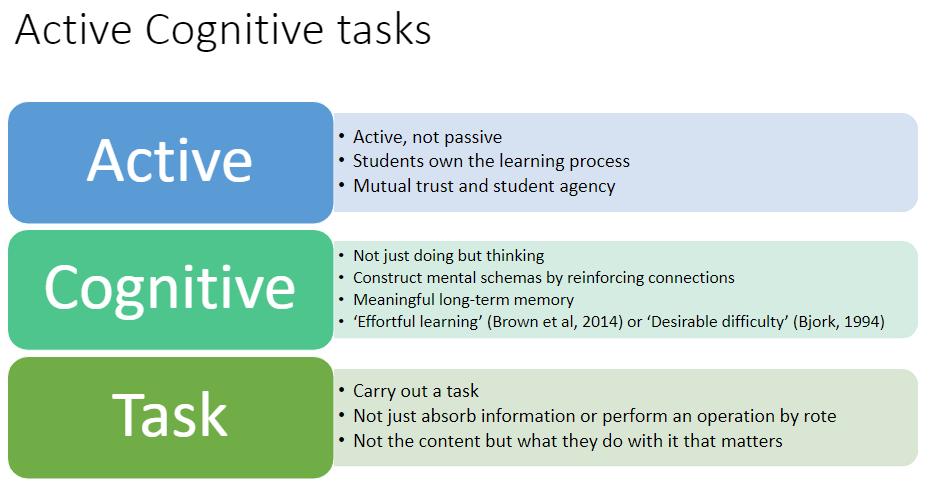
I’ve long been an advocate, but have noticed that different people often have very different conceptions of what active learning actually is. I have been inspired by the Active Learning Network. When the pandemic began, I wanted to support our teaching staff in using active learning online, so I designed a training session drawing upon seminal work such as Bonwell & Eison (1991), Michelline Chi’s ICAP model (2009), and the online student engagement framework (Redmond, et al, 2018). In considering such sources, my own conception of active learning came into clear focus as Active Cognitive Tasks (ACTs). This became the basis for my contribution to the SEDA Focus book. Here is an outline of what I mean by ACTs:

A list of active cognitive tasks is divided in to three sections of Active, Cognitive and Task. Under 'Active': Active, not passive; Students own the learning process; Mutual trust and student agency. Under 'Cognitive': not just doing but thinking; Construct mental schemas by reinforcing connections; Meaningful long-term memory; 'Effortful learning' (Brown et al, 2014) or 'Desirable difficulty' (Bjork, 1994). Under 'Task': Carry out a task; Not just absorb information or perform an operation by rote; not the content but what they do with it that matters
Summary of active cognitive tasks

References

Adkins-Jablonsky, S. J., Shaffer, J. F., Morris, J. J., England, B., & Raut, S. (2021). A tale of two institutions: analyzing the impact of gamified student response systems on student anxiety in two different introductory biology courses. CBE—Life Sciences Education, 20(2), ar19.

Bonwell, C. C., & Eison, J. A. (1991). Active learning: Creating excitement in the classroom. Washington, DC: School of Education and Human Development, George Washington University

Bjork, R. A. (1994). ‘Memory and metamemory considerations in the training of human beings,’ Metacognition: Knowing about knowing, edited by Janet Metcalfe and Arthur Shimamura, Cambridge, MA: MIT Press, pp. 185–205.

Brown, P. C., Roediger, H. L., and McDaniel, M. A. (2014). Make it stick: the science of successful learning, Cambridge, MA: The Belknap Press of Harvard University Press.  

Chi, M. T. H. (2009). Active-Constructive-Interactive: A Conceptual Framework for Differentiating Learning Activities. Topics in Cognitive Science, 1, 1, 73-105. 

Chiu, P. H. P., & Cheng, S. H. (2017). Effects of active learning classrooms on student learning: a two-year empirical investigation on student perceptions and academic performance. Higher Education Research & Development, 36(2), 269-279.

Garnham, W. A., & Gowers, I. R. (Eds.). (2023). Active Learning in Higher Education: Theoretical Considerations and Perspectives. Taylor & Francis.

Khan, A., & Madden, J. (2018). Active learning: a new assessment model that boost confidence and learning while reducing test anxiety. International Journal of Modern Education and Computer Science, 10(12), 1.

Redmond, P., Heffernan, A., Abawi, L., Brown, A., & Henderson, R. (2018). An Online Engagement Framework for Higher Education. Online Learning, 22(1), 183–204.  

Theobald, E. J., Hill, M. J., Tran, E., Agrawal, S., Arroyo, E. N., Behling, S., … & Freeman, S. (2020). Active learning narrows achievement gaps for underrepresented students in undergraduate science, technology, engineering, and math. Proceedings of the National Academy of Sciences, 117(12), 6476-6483.

Bios

A photograph of Wendy, a white woman with fair hair smiling at the camera.
Dr Wendy Garnham

Wendy Garnham is a Reader in Psychology at University of Sussex. She is a National Teaching Fellow and co-founder of the Active Learning Network. Wendy is a Fellow of SEDA and co-hosts both a Community of Practice for both Transitions and more recently, Outdoor Learning. Wendy is currently Acting Head and Director of Student Experience for the Central Foundation Year programmes at Sussex.

Mary Jacob, white woman with bright blue hair and wearing glasses faces the camera and has a beaming smile.
Mary Jacob

Mary Jacob is a Lecturer of Learning and Teaching at Aberystwyth University. She is based in the Learning & Teaching Enhancement Unit where she runs the Postgraduate Certificate in Teaching in Higher Education (PGCTHE) scheme. She holds SFHEA and CMALT, and is a member of the Active Learning Network. Mary contributes to the broader community of practice through curating the Weekly Resource Roundup, presenting webinars at events such as the #DigiEduWebinars series, and participating on Twitter as @MaryJacobTEL1

Missed the chat? No problem! Here’s a link to the Wakelet of curated tweets for you to catch up with the chat.

Posted in announcement | Leave a comment

#LTHEchat 260: Wellbeing, academic kindness, and social cure: paying it forward, led by Professor Julie Hulme @JulieH_Psyc

Image by Gordon Johnson on Pixabay

Academia has been (justifiably) subject to much criticism when it comes to staff wellbeing; high workloads, precarious contracts, individualism, discrimination, and bullying are just a few of the many problems (Morrish, 2019; Morrish & Priaulx, 2020). For doctoral students, depression and anxiety have been argued to be ‘the norm’ in the UK (Woolston, 2021). What can we do to transform the higher education sector, and how can we do it without burning ourselves out further?

In my experience of university employment, I’ve encountered serious toxicity, but also extreme generosity. My academic success is a direct consequence of support and academic kindness from my colleagues and my community. Indeed, some of my own research points to academic kindness as a key predictor of wellbeing in higher education (Holliman et al., 2019).

Within every university, there are people who make a difference. Sometimes we are fortunate enough to find networks beyond our own institution which introduce us to supportive individuals and communities. #LTHEchat is a prime example; my own Professors in Preparation community is another; and I have encountered many like-minded souls across the university learning and teaching community, including through the Association of National Teaching Fellows. Sometimes, we have to look beyond our immediate surroundings to find our “tribe”. In psychology, there is a growing body of research that shows that connecting with people who share our identity can act as a ‘social cure’ for poor wellbeing and mental ill health (e.g. Wakefield et al., 2022). Who is your community?

What can we do to be ‘that’ person, the one who makes a difference? Firstly, I believe we need to look after own health and wellbeing, managing our boundaries (including our workloads), and connecting with those who support us. If we’re psychologically well, we are in a better place to support others.

However, it’s not a case of simply ‘paying back’ what we receive from others. You may have seen US movie, Pay It Forward. The idea is that for every favour we receive, we do a new favour for three different people. These good deeds ‘snowball’ and spread beyond our own spheres of influence.

I suggest that a ‘pay it forward’ approach is one way to create a culture of academic kindness. I’ve found lots of ways to put it into practice. Having been supported by a peer mentor to apply for Readership, I worked with like-minded colleague Debbie Lock and others to create Professors in Preparation, so that others can receive similar mentoring. When being asked to undertake high-profile work for which I don’t have time (managing my workload!), I recommend junior colleagues who have appropriate expertise, to raise them up. I’ve lost count of the favours I’ve received, so I look for as many opportunities as I can find to ‘pay it forward’. I hope that in doing so, I’m helping to change academia for the better, culturally, and at sector level.

What opportunities do you have to ‘pay it forward’?

References

Holliman, A., Hulme, J.A., & Wilson-Smith, K. (2019). Transition and adaptability in educational and organisational contexts. Psychology Teaching Review, 25 (1), 4-11.

Hulme, J.A. & Lock, D. (2020). Professors in Preparation: Supporting 21st century professorial leaders. SRHEblog.com. Available at: https://srheblog.com/2020/04/02/professors-in-preparation-supporting-21st-century-professorial-leaders/.

Morrish, L. (2019). Pressure vessels: The epidemic of poor mental health among higher education staff. HEPi Occasional Paper 20. Available at: https://www.hepi.ac.uk/2019/05/23/new-report-shows-big-increase-in-demand-for-mental-health-support-among-higher-education-staff/.

Morrish, L. & Priaulx (2020). Pressure vessels II: An update on mental health among higher education staff in the UK. HEPi Policy Note 2023. Available at: https://www.hepi.ac.uk/2020/04/30/pressure-vessels-ii-an-update-on-mental-health-among-higher-education-staff-in-the-uk/.

Wakefield, J.R.H., Kellezi, B., Stevenson, C., et al. (2022). Social prescribing as ‘social cure’: A longitudinal study of the health benefits of social connectedness within a social prescribing pathway. Journal of Health Psychology, 27 (2), 386-396. https://journals.sagepub.com/doi/full/10.1177/1359105320944991.

Woolston, C. (2021). Depression and anxiety ‘the norm’ for UK PhD students. Nature Career News. doi: https://doi.org/10.1038/d41586-021-03761-3.

Bio:

Julie Hulme is a Professor of Psychology Education in the School of Social Sciences at Nottingham Trent University. She is a National Teaching Fellow, and a Principal Fellow of the HEA. A Chartered Psychologist, Julie applies psychological theories and research methods to developing inclusive teaching and learning in higher education, and is particularly proud of her work with disabled student researchers to improve accessibility, inclusion, and belonging through transformation of university policy and practice. In 2018, Julie co-founded the Professors in Preparation network, providing a community of learning for teaching- and practice-focused academics to support each other in career development and progression. She actively champions the scholarship of teaching and learning and those who undertake it across the sector, and has worked with several universities to develop cultures, communities, and promotions criteria that reward both scholarship and citizenship. Julie sees herself as a “positive disruptor”, challenging the status quo and promoting kindness among staff and students in higher education. You can follow Julie on Twitter @JulieH_Psyc, and read more about her work at her blog, https://higherpsyched.home.blog/.

LINK to the wakelet

https://wakelet.com/i/invite?code=41qfcq55

Posted in announcement | Tagged , , , , , | Leave a comment

#LTHEchat 259: ChatGPT and academic integrity Led by @profdcotton Dr Peter Cotton and @reubenshipway

ChatGPT and similar large language models (LLMs) have taken the academic world by storm, and across the globe, there are similar slightly panicked meetings going on about what this means for the future of assessment in higher education. Conflicting views abound as to the benefits and challenges of ChatGPT and the new era of artificial intelligence, with several commentators arguing that the ‘moral panic’ is overblown and many making a compelling case for teaching students how to use LLMs as part of developing employability skills. But how do we get students to learn if they can ask a chatbot for the answers to many of our traditional assessment questions? Is it plagiarism, or academic misconduct if students use ChatGPT to help with their assessments? Can we ‘design out’ ChatGPT (creating assessments designed to reduce the likelihood of it being used) in the same ways that we try to design out plagiarism? Will authentic assessments help – or can ChatGPT do these too? Do we even need students to have knowledge of their discipline – or is this now a redundant issue, confined to earlier generations where every fact was not at our fingertips? Or are there actually wider issues of student (dis)engagement that ChatGPT is bringing into sharp relief? The answers, as ever, are not black and white. 

As early adopters of ChatGPT, we experimented with various uses of the tool, including getting it to write session plans, institutional policies, and job descriptions. At the time ChatGPT was released, Reuben & Pete were marking essays written by first-year Marine Biology students.  Although they didn’t detect any examples of academic dishonesty, they were nonetheless quite shocked by how well ChatGPT could structure and write one of these essays. Admittedly, its first attempts were often quite superficial, but iterating this with revised prompts and asking it to incorporate material copied from a key paper, often resulted in something fairly robust and likely to escape detection without forensic examination. This led us to thinking more about ChatGPT and academic integrity, resulting in the paper entitled ‘Chatting and Cheating. Ensuring academic integrity in the era of ChatGPT which we uploaded on a pre-print site on January 11th. Reuben also gave a talk about ChatGPT at the UCL Global Business School for Health, which you can view here: https://www.youtube.com/watch?v=ngMqAtcPaj4&list=PL0BPVluk7u3dkLbyhFSKbA4iv1N7SdmQ3&index=2&ab_channel=UCLGlobalBusinessSchoolforHealth 

Join us in the #LTHEchat to share your experiences and ideas about the risks of ChatGPT as well as to consider how we can make use of such tools in an inclusive and pedagogically sound way.

Guest biography

Professor Debby Cotton (@profdcotton) is the Director of Academic Practice at Plymouth Marjon University. She is a Principal Fellow of the UK Higher Education Academy (PFHEA) and a National Teaching Fellow and has published over 70 articles on higher education teaching and learning, mostly without the assistance of ChatGPT. You can find out more about her research here: https://www.marjon.ac.uk/about-marjon/staff-list-and-profiles/cotton-debby.html    

Dr Peter Cotton is an Associate Professor in the School of Biological and Marine Sciences at the University of Plymouth. Although primarily an ecologist, he has published several pedagogic papers (all with the assistance of Prof D. Cotton) and is a Senior Fellow of the UK Higher Education Academy (SFHEA). You can find out more about him here: https://www.plymouth.ac.uk/staff/peter-cotton

Profile picture of Professor Debby Cotton & Dr Peter Cotton

ChatGPT prompt > In the style of the previous short bios, write a similar blurb for Reuben Shipway (@reubenshipway), who is a lecturer in marine biology at the University of Plymouth:

Dr Reuben Shipway (@reubenshipway) is a Lecturer in Marine Biology at the University of Plymouth. He is a Fellow of the UK Higher Education Academy (FHEA) and has published a number of papers on topics such as coastal ecosystems and the impacts of climate change. He is a passionate advocate for the conservation of our oceans and marine wildlife and is committed to teaching and inspiring the next generation of marine biologists.*

*This was generated by ChatGPT and almost none of it is accurate. If you want to know more about Reuben, check out the following: https://www.plymouth.ac.uk/staff/reuben-shipway @reubenshipway

Profile picture of Dr Reuben Shipway
Posted in announcement | Tagged | 1 Comment

#LTHE chat 258 Work/practice based learning and the role of simulation/ immersive learning. Discussion led by @DebbieRoberts6

Nurising simulation

Simulation has become increasingly common as an approach to teaching and learning; particularly in the vocational or practice based disciplines. Indeed for some vocational professions, engaging in simulation can be used instead of practice in real world environments; however whether this simulated experience can ever truly replace practice experience remains unclear. Generally, simulation for learning tends to take place away from work based or practice areas; rather it takes place in specifically designed laboratories or skills room facilities, or simulation suites, facilitated by teachers that are situated largely within the university setting. This Tweet chat seeks to explore whether simulation is taking place in the workplace, and if so, what form is that simulation taking and what is the impact of this on learning? And, perhaps more importantly, what preparation do individuals require to facilitate such learning in the workplace? Finally the Tweet chat is looking for examples of collaboration between higher education and workplaces where simulation is being used to good effect; or could be used even more.

Please join us for this conversation to share your examples of simulation in the workplace and to discuss the impact of simulation on practice.

Presenter Prf Debbie Roberts

Professor Debbie Roberts has expertise in nurse education, with over 30 years’ experience as a Registered Nurse, and 20 years as a nurse academic, working for universities in both Wales and England.  Debbie is a Principal Fellow of the HEA/Advance HE, her areas of teaching and research expertise includes practice learning, immersive learning, simulation and workforce development. She has a particular interest in linking research, teaching and innovation; ensuring that evidence-based teaching is used within nurse education and embedding relevant research into the curriculum.  Debbie supports PhD students and has examined several PhD candidates. Widely published in the field of nurse education, Prof Roberts has contributed to textbooks, used internationally as core texts in nurse education programmes. She also has published over 30 peer-reviewed papers for international journals with her work often cited by others, indicating the impact of her ideas on teaching and learning internationally.   Prof Roberts has established a wide range of national and international links through her work as an external examiner and in 2019, she was nominated as one of the top 100 women in Wales in the inaugural Welsh Women’s Awards, which celebrate those women who continue to thrive and excel at the forefront of their professions and make meaningful contributions to the country. 

Link to the #LTHE chat Wednesday 8th March

Posted in announcement | Leave a comment

#LTHEchat 257: Student led use of social media for professional networking and more in a higher education setting. Led by @neilwithnell and @karolinaviolet

Selection of social media logos and mobile phones

Image by Gerd Altmann from Pixabay

The use of social media by higher education students has been found to improve communication resulting in increased involvement and engagement (Lacka et al., 2021). Some of the reasons for students engaging in social media are; social interaction and integration (Neier & Zayer, 2015), future career building and professional networking (Josefsson et al., 2016) and reducing loneliness when on an international placement (Sleeman et al., 2020). Although studies have shown a positive attitude towards the use of social media in higher education (Romero-Hall, 2017; Cooke, 2017), there have also been apprehensions against its implementation and mainstream use. Lacka et al (2021) discuss how social media was not created in an educational context and that its suitability raises ethical concerns including social exclusion and digital division.

Other concerns regarding social media use by higher education students are also surrounding distraction from educational work ‘blurring’ the distinction between personal and academic online spaces (Sleeman et al., 2020). However, it has been argued that social media is an effective tool for developing network connections, finding placement opportunities, and improving employability skills (Lacka et al., 2021; Romero-Hall, 2017). Questions are also raised around the ‘professional presence’ on social media, and which platforms can be kept strictly professional (Josefsson et al., 2016).

Many institutions and professional bodies have released guidelines on social media use for anyone who is affiliated with their name, including universities. These social media guidelines typically include themes such as information governance, online behaviours and risk mitigation (Lees, 2018). These sets of rules and recommendations are to protect the account holder, as well as the affiliated institution and must be abided by to ensure a safe and civil online presence. It is interesting how opinions on social media use differs, depending on perspective and perceived purpose, as well as how organisations have had to adapt their policies to include social media usage and ensuring individuals maintain a good digital footprint.

From personal experience, social media has been very beneficial and looking forward to discussing, debating and learning about your views and experiences! Join us on Wednesday 1st March between 20:00-21:00 for the next #LTHEchat.

References

Cooke, S. (2017). Social teaching: Student perspectives on the inclusion of social media in higher education. Education and Information Technologies, 22, 255-269. https://doi.org/10.1007/s10639-015-9444-y

Josefsson, P., Hrastinski, S., Pargman, D. & Pargman, T. C. (2016). The student, the private and the professional role: Students’ social media use. Education and Information Technologies, 21, 1583-1594. https://doi.org/10.1007/s10639-015-9403-7

Lacka, E., Wong, T. C. & Haddoud, M. Y. (2021). Can digital technologies improve students’ efficiency? Exploring the role of Virtual Learning Environment and Social Media use in Higher Education. Computers and Education, 163, Article 104099. https://doi.org/10.1016/j.compedu.2020.104099

Lees, R. (2018). Social media policies in UK Higher Education Institutions – An overview. [conference paper]. International Conference on Social Computing and Social Media, Copenhagen, Denmark. https://doi.org/10.1007/978-3-319-91521-0_34

Neier, S. & Zayer, L. T. (2015). Students’ perceptions and experiences of Social Media in Higher Education. Journal of Marketing Education, 37(3), 133-143. https://doi.org/10.1177/0273475315583748

Romero-Hall, E. (2017). Posting, sharing, networking and connecting: Use of social media content by graduate students. TechTrends, 61, 580-588. https://doi.org/10.1007/s11528-017-0173-5

Sleeman, J., Lang, C. & Dakich, E. (2020). Social media, learning and connections for international students: The disconnect between what students use and the tools learning management systems offer. Australasian Journal of Educational Technology, 36(4), 44-56. https://doi.org/10.14742/ajet.4384

CHAT HOSTS

Karolina Staniecka is a final year Student Nurse at the University of Salford with interests in digital skills and social media for students in Higher Education. @karolinaviolet

Neil Withnell is Associate Dean academic Student Experience at the University of Salford with a passion for digital education and social media. @neilwithnell

Wakelet from the chat is here:

https://wakelet.com/wake/HTUhCrMmZ4uwkiPWPfr7V

Posted in announcement | Tagged , , , , | Leave a comment

#LTHEchat 256: LGBTQ+ Inclusion in Higher Education. Led by @j_glazzard

Rainbow colour flag

Attempts to queer the higher education curriculum have not been universal, and literature suggests that courses continue to be strongly heterosexual (Formby, 2015). Although some universities celebrate annual events such as Pride and include a commitment to LGBTQ+ equality in their policies, there is evidence in the literature that the higher education curriculum does not seriously address issues or concerns around LGBTQ+ equality. Students continue to be presented with the achievements of the ‘same old straight, white men’, and the curriculum is ‘pale, male and stale’ (student participants in Formby, 2015, p. 32). For example, evidence suggests that LGBTQ+ content is invisible in some health courses (Formby, 2015), thus presenting students with only a partial perspective of their disciplines. This is surprising given the association between mental health and LGBTQ+ (Bradlow et al., 2017). 

Aldridge and Somerville (2014) found that nearly a quarter of LGBTQ+ students thought they would face discrimination from other students. Research has also found that fears relating to prejudice and discrimination negatively impacted levels of ‘outness’ in universities (Formby, 2012; 2013; 2015). This suggests that even where bullying, prejudice and discrimination are not experienced directly, fears around these can negatively impact on LGBTQ+ students’ experiences of higher education. Thus, campus climate can be influenced by overt or covert factors.  Keenan (2014) found that despite institutional commitments to equality and diversity, the lived experiences of LGBTQ+ students suggest that these policies are often not borne out in practice. Thus, university spaces, once described as ‘threateningly straight’ (Epstein et al., 2003, p. 138), are places where varying levels of ‘outness’ or self-censorship (Formby, 2012; 2013) may exist.

Further consideration is needed to address ways higher education institutions can address LGBTQ+ inclusion. Central to advancing social justice for queer students is the need for a university-wide approach which positions students as active agents of change. Consideration will need to be given to the higher education curriculum, staff training, marketing and recruitment.

Jonathan Glazzard, Edge Hill University

References

Aldridge, D., & Somerville, C. (2014) Your services your say: LGBT people’s experiences of public services in Scotland, Edinburgh: Stonewall Scotland. 

Bradlow, J., Bartram, F., Guasp, A., and Jadva, V. (2017), School Report: The experiences of lesbian, gay, bi and trans young people in Britain’s schools in 2017, London: Stonewall. 

Epstein, D., O’Flynn, S. & Telford, D. (2003), Silenced sexualities in schools and universities, Stoke on Trent: Trentham Books. 

Formby, E. (2012), Solidarity but not similarity? LGBT communities in the twenty-first century, Sheffield: Sheffield Hallam University 

Formby, E. (2013), Understanding and responding to homophobia and bullying: Contrasting staff and young people’s views within community settings in England, Sexuality Research and Social Policy, 10, (4), 302-16. 

Formby, E. (2015), # FreshersToFinals From freshers’ week to finals: Understanding LGBT+ perspectives on, and experiences of, higher education, Sheffield Hallam University.

Keenan, M. (2014) Coming out and fitting in: A qualitative exploration of lesbian, gay, bisexual, trans and queer students’ university experiences, Nottingham: Nottingham Trent University.   

Link to the Tweet chat with Prof Jonathon Glazzard

Posted in accessibility, equity | Tagged , | Leave a comment

#LTHEchat 255: Potential of Podcasting Practice as a Learning Space in Higher Education. Led by @santanuvasant

Image with text "Podcast on air"
Image with text “Podcast on air”

For this week’s #LTHEChat 255, we will be exploring the potential of podcasting practice as a learning space in higher education. 

It was during a LTHEChat tweetchat session in January 2020 that I had the idea for a Higher Education podcast that would be a learning space to speak on topical subjects and build a shared understanding of Higher Education. I had not had any experience of podcast production before. Then the pandemic hit, which was an opportunity to build on this idea. Together with Brian Hipkin and Dr Emily McIntosh, we came up with format ideas and a name, TalkingHE. In December 2020, TalkingHE was launched. Why not take a listen to the over 25 episodes that have been recorded via: https://anchor.fm/talkingHE or wherever you get your podcasts. You can read more about my experience of setting up a Podcast during a pandemic via my case study article in the University of the Arts London’s Spark Journal (Vasant, 2022).

There is great potential for educators to use more audio in their teaching and for students to use more audio in their learning in my disciplines and that through audio, there is a connection and focus and a shared sense of learning space. Before writing, knowledge was often handed down through generations by spoken words. It is also an effective way to teach many subjects (On Tam, C, 2012).  With the advent of cheap audio recording via computers, the pandemic and the use of platforms such as Zoom or Teams, anyone can now record audio and with some simple editing create and host a podcast. 

The opportunities for inviting and recording episodes from experts in your field, for bite-size content of knowledge or feedback and so on are endless, as well as the use of podcasting as a tool for assessments where you want students to synthesise and present a large amount of information in a short time frame. 

Educators from across the sector are seeing the use of podcasting and the use of sound only as more accessible way to teach their disciplines, for students to learn when and wherever they may be and assess through this medium. Now more than ever we need to be creative in the way we use technology and the potential of podcasting as a practice is significant. 

I invite you to share your experiences of listening to podcasting, of producing podcasts and exploring the potential of podcasting practice as a learning space in Higher Education!  

References 

On Tam, C. (2012) ‘The effectiveness of educational podcasts for teaching music and visual arts in higher education’, Research in Learning Technology, 20(1). https://doi.org/10.3402/rlt.v20i0.14919

University College London(no date)(a) Getting started with podcasting at UCL. Available at: https://www.ucl.ac.uk/staff/communications-digital-and-marketing/digital/getting-started-podcasting-ucl (Accessed: 1st February 2023). 

University College London(no date)(b) Podcasts & Audio Content. Available at: https://wiki.ucl.ac.uk/pages/viewpage.action?pageId=137158565. (Accessed: 1st February 2023). 

Vasant, S (2022). Talking higher education: starting a podcast during the pandemic. UAL Spark Journal. Available at: https://sparkjournal.arts.ac.uk/index.php/spark/article/view/170  (Accessed: 1st February 2023). 

Guest biography

Santanu Vasant is an Educational Developer (Reward and Recognition) at the University of the Arts London. He has a BSc (Hons) in Multimedia Technology and Design, a PGCE in Secondary ICT from Brunel University London and a Masters in Education from UCL. He is a Principal Fellow of the Higher Education Academy. Santanu has over 18 years of experience in Higher Education in a variety of Academic Development roles and as a secondary school teacher of ICT. His research interest is in the field of designing physical and virtual learning spaces. He has written book chapters on the use of

  • PebblePad e-Portfolios for Business Education in Pebblegogy (2011)
  • Bring Your Own Device – policy and practice in higher education in Smart Learning (2015)
  • Academics’ Understanding of Learning Spaces: Attitudes, Practices and Outcomes Explored through the Use of Social Media in Social Media in Higher Education: Case Studies, Reflections and Analysis (2019) and Would I lie to you? Checking knowledge in pre-reading, listening or watching tasks in 100 Ideas for Active Learning (2022j).

Since December 2020, Santanu is the creator and host of the TalkingHE podcast series and the related Twitter channel @TalkingHEPod. He is an editor of the Staff and Educational Development Association (SEDA) Educational Developments Magazine and a reviewer for the Association for Learning Technology’s Journal Research in Learning Technology. You can reach out to him on Twitter @santanuvasant and check out his website http://www.santanuvasant.com.

Profile picture of Santanu Vasant
Posted in announcement | Tagged , , | 1 Comment

#LTHEchat 254: Hybrid working: new frontiers in professional practice. Led by @MarenDeepwell

Image of a team leader doing a team review with his team virtually.
Image of a team leader doing a team review with his team virtually. (Source: iStock)

For #LTHEChat 254 we are going to shift our focus from learning to work. We will explore ways in which learning and teaching practices can inspire a more sustainable and equitable hybrid workplace.

Digital technologies enable remote and hybrid working in new and more connected ways, but it is by no means a new practice. Many industries have depended on home working over the centuries. In the UK we are at the beginning of a new era of widespread homeworking, prompting urgent questions about the rights of hybrid workers, working conditions, and how new working practices may increase inequality. Some workers may now have more flexibility working from home, but the pressures of competing demands such as caring for children or other family members whilst earning an income remain constant. Other issues such as the increasing digital surveillance of employees and privacy concerns around hybrid working practices further highlight the need for a careful and considered approach to setting out policies for the future of working remotely.  

One indicator of the changes in how we work is new laws and policies that seek to formally express how the relationship between employers and their digitally connected and increasingly distributed workforce is changing.  For example, in the UK we have not yet seen an introduction of a code that would give employees a legal right to disconnect, whilst other countries, including France (2016), Italy (2017), Spain (2018), and Portugal (2021) have introduced such policies over the past five years and others including Ireland are working towards doing so. 

We invite you to share your experiences of hybrid working and critically reflect on some of the downsides alongside the positives. What do we gain when we move beyond simply translating office-based practices and envisage a truly hybrid way of working? How can we help create welcoming and warm hybrid places to work that help sustain well-being and work/life balance? How can we empower ourselves and others in making hybrid working an equitable and engaging reality that benefits the organisation and the individual alike? 

We are at a watershed moment for remote working in the sense that we have an opportunity to set out a vision for what is ahead that is informed by lessons from the past, as well as, the shift in perspective that the pandemic has brought about. 

In 2017, I set out to find creative and fun ways to work and build meaningful relationships in the virtual workplace. The resulting Open Access book, Leading Virtual Teams, brings together case studies and practical advice to build on. This LTHEchat #254 offers an opportunity for a conversation about current practices and how things are changing. 

Join us to share your own inspiration, questions, and prompts for reflection. From recruitment and induction to establishing effective and sustainable ways of working in the hybrid workplace we will explore the highs and lows of what it means to work in hybrid organisations in the long term. 

Guest biography

Dr Maren Deepwell @MarenDeepwell is the CEO of the Association for Learning Technology and a professional coach, working with organisations and emerging leaders in education and the not-for-profit sector. 

Profile picture of Dr Maren Deepwell

Posted in announcement | Tagged , | 1 Comment