#LTHEchat 54. 11 May. ‘Students are asking questions … about assessment and exams’

7839213382_51f7638dea_z

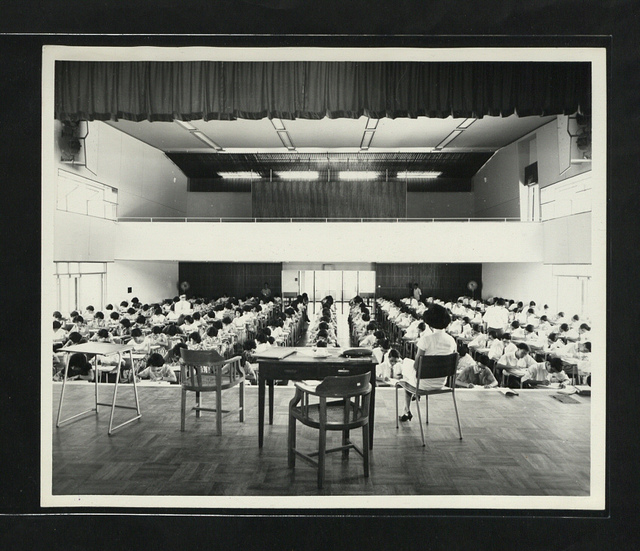
Teacher Training in Hong Kong. End-of-term examinations in progress in the main hall at Northcote Training College. Out of 390 who sat, 375 passed. The National Archives UK. Sourced from the Flickr Commons: https://flic.kr/p/cWJ22q.

In March we hosted a very special LTHEchat with Haleh Moraj and her students at MMU which we called Students are asking questions. It was so successful and generated so much interest that we thought that students asking questions (#HEStudentQ) would be a good topic to return to from time to time.

As exam season rolls around again, now seems to be a good to ask our colleagues in the LTHEchat community some questions that students are sure to have about examinations and other forms of assessment. For example:

  • Why do we assess students using examinations?
  • Is it a sophisticated form of torture or are there real benefits for the students who sit exams and the teachers who set and mark them?
  • Or is it just the most convenient form of assessment for Universities in this age of mass education?

We have some questions on this topic that were left over from LTHEchat 49 but we would like to invite our student readers (or indeed our colleagues) to suggest questions that they have about examinations and assessment using our Student Voice form. You can also submit questions via twitter using the hashtags #LTHEchat and #HEStudentQ. We’ll choose a selection of the best in the LTHEchat that will take place between 8-9 PM BST on Wednesday, 11 May.
The Storify can be found here :

https://storify.com/LTHEchat/lthechat-54-student-questions

Network visualisation using Martin Hawksey’s (@mhawksey) TAGSexplorerhttp://bit.ly/lthechat54.

If you are reflecting on this specific #LTHEchat please share your post with us so that we can reblog.

If you participated/are participating in any way in the #LTHEchat, please complete our short survey and let us know if you have other suggestions on how we could make the #LTHEchat more valuable for you. Thank you.

See you Wednesday, same time, same place 😉 – 8-9PM BST #LTHEchat

Posted in announcement | Tagged , , , | 2 Comments

#LTHEchat No 53 with Dr Mark McGuire @mark_mcguire

MarkMcGuire

Dr Mark McGuire

We might summarise the changing use of digital networks in education as follows:

Changing Paradigms in Teaching and Learning
Locus, Mode, Temporality, Structure, Objective

PUSH
Institutional, broadcast, synchronous, hierarchical, impart knowledge

PULL
Personal, download, asynchronous, nodal, individual learning

SHARE
Everywhere, co-create, continuous, networked, knowledge network

The structure and practice of teaching and learning is becoming more like an ongoing conversation between diverse individuals in different locations around shared interests. As Joichi Ito, Director of the MIT Media Lab, says, we are moving “from a container to a network” (http://goo.gl/zkjQAH). Educators around the world are working out how to use digital tools to open up and connect their classes to external networks in real time. Well known examples include #DS106 (Digital Storytelling, University of Mary Washington, http://ds106.us/) and #phonar (Photography and Narrative, Coventry University, https://phonar.org/). Jonathan Worth (@Jonathan_Worth), a Research Associate at Newcastle University, is currently coordinating Connecting Classes (#CClasses), a global, collaborative teaching and research project to investigate the use of Twitter in opening up and connecting classes (http://goo.gl/cPDqFB). As well as connecting to others with shared interests over open networks, #CClasses also aims to facilitate learning that is interest-driven, production-centred, peer-supported and academically oriented, in keeping with the principles advocated by the Connected Learning Alliance (http://goo.gl/wMYkUt). This project sparked the idea for using Connecting Classes as a topic, and a prompt, for this week’s #LTHEchat. In preparation for the chat, you might wish to check out the #CClasses hashtag and the Connecting Classes website (http://goo.gl/cPDqFB).

Dr Mark McGuire has taught Design at the University of Otago since 1994. Before moving to New Zealand, he ran Mediatrix inc, a Design consultancy in Toronto that helped publishers make the transition from analogue to digital print production from the mid 1980s. Dr McGuire holds a BA, a Bachelor of Environmental Studies (Pre-Professional Architecture), a Masters in Information Science and a PhD in Media Studies. He teaches Communication design, Design for Innovation, Experience Design, and Social Media. His research interests include open education, online communities, and digital media theory and practice.


Twitter: @mark_mcguire

Blog: https://markmcguire.net/

________________________________________


Dr. Mark McGuire

Senior Lecturer, Design

Work email: mark.mcguire@otago.ac.nz

Personal email: markhtmcguire@gmail.com

Personal mobile: 021-207-6521

Twitter: @mark_mcguire (fastest, most efficient mean of communication)

Blog: http://markmcguire.net/

Instagram: https://www.instagram.com/mark_mcguire/

Flickr: https://www.flickr.com/photos/25916400@N07

SlideShare: http://www.slideshare.net/mark.mcguire/edit_my_uploads

SoundCloud: https://soundcloud.com/mark_mcguire


The Storify is #LTHEChat 53: Connecting Classes.

The TAGSexplorer 6 visualisation is LTHEchat 53.

If you are reflecting on this specific #LTHEchat please share your post with us so that we can reblog.

If you participated/are participating in any way in the #LTHEchat, please complete our short survey and let us know if you have other suggestions on how we could make the #LTHEchat more valuable for you. Thank you.

See you Wednesday, same time, same place 😉 – 8-9PM BST #LTHEchat

Posted in Uncategorized | 2 Comments

#HEAchat/#LTHEchat on Teaching and Learning in Law – Opinions Welcome

It’s the last Wednesday in the month which means that this week’s #LTHEchat will be joining forces with #HEAchat again. The topic this week is Teaching and Learning in Law and it’s being led by Ben Brabon who will be tweeting as @HEA_chat.

At the time of going to press, the LTHEchat team knows little more about what will be covered than the title. But as usual, friend of #LTHEchat and Golden Tweeter, Simon Rae has visualized his take on the topic:

We’re sure that the LTHEchat regulars will have much to contribute, and we look forward to welcoming new folks from the HEA, Social Sciences and Law Communities.

In tweets posted today, there is some indication of useful background reading:

When joining this week’s chat, please use both hashtags #HEAchat and #LTHEchat.

We’ll storify and TAGSExplore the chat after the event.

You can also view the TAGS Searchable Twitter Archive.

Posted in announcement | Tagged , , | Leave a comment

#LTHEchat 52: Managing negative use of social media and cyberbullying, Dr Bex Lewis

Dr Bex Lewis

Dr Bex Lewis (@drbexl), Manchester Metropolitan University

I’m Senior Lecturer in Digital Marketing at Manchester Metropolitan University, with a particular interest in digital culture, especially within faith and values-focused organisations. Previous roles in academia include ‘Senior Fellow in Technology Enhanced Learning’ alongside temporary lectureships, web editorial work, and research projects (including into web accessibility and usability, and a JISC funded project into organisational change) at the University of Winchester, Research Fellow in Social Media and Online Learning at Durham University, and Interdisciplinary Research Officer at the University of Manchester. My history PhD (2004) focused upon ‘The planning, design and reception of British home front propaganda posters of the Second World War’, including the original history of the now infamous ‘Keep Calm and Carry On Poster’.

I have been Director of social media consultancy Digital Fingerprint since 2001, with clients including Girlguiding, The National Archives, NCVO, and a range of universities and Christian organisations. My emphasis is upon the digital is as enabler, rather than as a replacement for other communications media. I am author of Raising Children in a Digital Age (Lion Hudson, 2014), which reprinted five months after publication, and has recently been translated into Italian, with Chinese following later in the year. The Financial Times described the book as ‘sensible’ in a sea of scare texts around the topic of children and the internet. I have been on flagship shows such as The One Show (BBC One), Steve Wright in the Afternoon (BBC Radio 2) and BBC News, whilst local and specialist media frequently asks for comment or opinion pieces on aspects related to digital culture.

Managing negative use of social media and cyberbullying

The material on cyberbullying was some of the most difficult to write for Raising Children in a Digital Age, because there is no ‘magic bullet’ to deal with it, the factors involved are complex, and for those affected, it’s hugely problematic. Youth sectors of the church have asked for talks on managing bullying, and it always comes up in wider discussions, as bullying is believed to have increased with the always-on nature of digital technology. The New York Times noted in early 2013, there’s been a huge surge in anti-bullying books, spurred on by media coverage, particularly of high-profile cases where social media has “driven” users to suicide.  The media suggestion that there is a cyberbullying epidemic tends to encourage (children) to think that they can send hurtful messages because “everyone else is doing it”. 
Whilst these worst-case scenarios are tragic, most are much more complex than the headlines would have us believe. Headlines typically fall for the argument of “technological determinism”: a sense that each new form of technology comes with new ways of doing things, in which we have no say, and no resistance. It is more helpful to understand that all new technologies come with new possibilities for ways of doing things, some good and some bad, and that we have choices about how we put them to use: whether that form of technology is the Biro, a watch, an iPad, a rocket, or a nuclear bomb. There are no easy answers, but certainly plenty to talk about.

The Storify is here: https://storify.com/LTHEchat/lthechat-52

The TAGSexplorer 6 visualisation is here: http://bit.ly/lthechat52

If you are reflecting on this specific #LTHEchat please share your post with us so that we can reblog.

If you participated/are participating in any way in the #LTHEchat, please complete our short survey and let us know if you have other suggestions on how we could make the #LTHEchat more valuable for you. Thank you.

See you Wednesday, same time, same place 😉 – 8-9PM BST #LTHEchat
The LTHEchat team

Posted in guest | Tagged , | 3 Comments

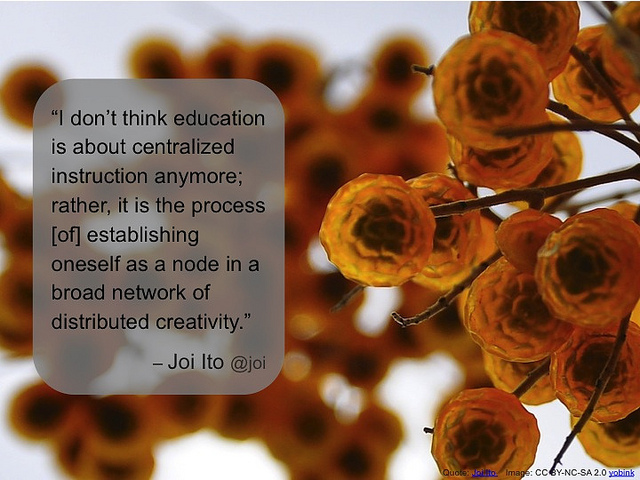
#LTHEchat 51: Networks of distributed creativity with Laura Gogia, Frances Bell and Catherine Cronin

9615402451_cfd5e7db3e_z

CC BY 2.0 catherinecronin (Flickr) https://flic.kr/p/fDFs9T

We – Laura Gogia, Frances Bell and Catherine Cronin – have worked for the last year on preparing an interactive symposium for Networked Learning 2016 that looks at the Networked Learning Community in the context of other communities and networks in open and connected learning. Not wishing to confine ourselves to the face to face symposium we are reaching out to others, before, during and after.

So LTHEchat community – will you engage with us and share your ideas? Will you become nodes in this broader network? Can we become nodes in your broader networks? How do you bridge different networks and communities in which you work and learn?

We want to hear your ideas and bring them to our symposium — on negotiating openness as educators and learners; blending informal and formal learning spaces; and the potential as well as the limits of the networks. We will, of course, bring back the outcomes of the symposium that you can follow on #NLbridge (before, during and after the Networked Learning Conference) and live on #nlc2016 at our symposium in May.

About this week’s guest facilitators

i3EVSzB0

Laura Gogia (@GoogleGuacamole) is a research fellow in the Division of Learning Innovation and Student Success at Virginia Commonwealth University.  She recently completed her PhD in educational research with an emphasis in the design and assessment of digital learning experiences.

fbcomp

Having retired from lecturing and researching in 2013, Frances Bell (@francesbell) now describes herself as an Itinerant Scholar, learning, researching and writing on the web. That is, of course, when she isn’t travelling or working/playing in her garden.

FADcwktb

Catherine Cronin (@catherinecronin) is an educator, researcher and PhD candidate at the National University of Ireland, Galway. Catherine’s work focuses on openness and open education, digital identity practices, and navigating the boundary between formal and informal learning; her PhD research is exploring open educational practices in higher education.

The Storify is here: LTHEchat 51: Networks of Distributed Creativity

Network visualisation using Martin Hawksey’s (@mhawksey) TAGSexplorerhttp://bit.ly/lthechat51.

If you are reflecting on this specific #LTHEchat please share your post with us so that we can reblog.

If you participated/are participating in any way in the #LTHEchat, please complete our short survey and let us know if you have other suggestions on how we could make the #LTHEchat more valuable for you. Thank you.

See you Wednesday, same time, same place 😉 – 8-9PM BST #LTHEchat

The LTHEchat team

Posted in collaboration, guest | Tagged , , , , | 2 Comments

#LTHEchat 50 6 April – Students as Partners with Professor Julie Hall @julieh8 and students

‘It seems strange now to imagine a time when universities did not want to work with students as partners in initiatives to enhance the student experience. But what do such partnerships look like in practice  and are all students regularly included? In the UK The HE Academy and the Quality Assurance Agency have both funded a range of projects to  identify key issues affecting students  and methods for engaging students as partners . Annually the National Student Survey, allows final year undergraduates to tell universities how satisfied they are with their experience but this is a limited version of listening to student voice. Partnership working has been held up as an antidote to ‘students as consumers’ yet there are challenges:

  • Teaching remains something that is more often than not controlled by the lecturer, something that is ‘done to’ the students rather than co -created between lecturer and student. Yet study is already going on in the lives of students, including when they walk into a classroom and before they start a university course. Can students truly be partners in undergraduate learning? What would have to change to make this happen? What do students want?
  • While universities can work hard to encourage the involvement of students in quality assurance, enhancement and change initiatives, many students are just not interested and those who do get involved may not be representative of the wider student body. This kind of work can therefore be challenging and exciting and frustrating at the same time. How can we bring hidden voices to the fore? How can we encourage students to see the value of working in partnership? Are partnerships more about taming the student voice than real change?
  • As Healey, Flint, and Harrington (2014 ) say, ‘ Although partnership has been described foremost as process, rather than a product or specific outcome, we still know relatively little about the ‘how’ of learning partnerships in practice, and particularly with respect to disciplinary approaches to partnership. There is a need for work that develops understandings of partnership in connection with scholarship, practice, signature pedagogies and the epistemology of different disciplines and professional spheres. (p.60) Are there disciplinary differences we should take notice of? Are some disciplines more able to offer partnership working?

The discussion will be hosted by Professor Julie Hall and students from Roehampton University – a university with a proud history of working closely with students. ’

Prof Julie HallProfessor Julie Hall is a former Director of Learning and Teaching and former co-chair of the UK Staff and Educational Development Association and is now Deputy Provost at The University of Roehampton.  Julie is a National Teaching Fellow, SEDA Senior Fellow and has taught at undergraduate and post graduate level over twenty years. Julie has written extensively on academic professional development, access to higher education, race and gender and pedagogic practice and change management in higher education. Julie’s applied research has regularly involves students as partners and co-creators of knowledge and Julie has run workshops on this topic for SEDA and for the HE Academy

The Storify is here: LTHEchat 50: Students as Partners with @julieh8 and students.


If you are reflecting on this specific #LTHEchat please share your post with us so that we can reblog.

If you participated/are participating in any way in the #LTHEchat, please complete our short survey and let us know if you have other suggestions on how we could make the #LTHEchat more valuable for you. Thank you.

See you Wednesday, same time, same place 😉 – 8-9PM BST #LTHEchat

The LTHEchat team

Posted in guest | Tagged | 2 Comments

The night #LTHEchat tweet-jacked #EDENchat

Young girl entertaining Mickey Mouse and other friends at a make-believe tea party, 1930s
Young girl entertaining Mickey Mouse and other friends at a make-believe tea party, 1930s. State Library of Queensland via Flickr Commons.

#EDENchat, the fortnightly tweet-chat run as part of the European Distance and E-learning Network (EDEN) and coordinated by friend of #LTHEchat Steve Wheeler (@stevewheeler AKA @timbuckteeth), usually takes place at the same time as #LTHEchat. But last night, prompted by this tweet by Simon Horrocks:

a rebel alliance was spontaneously formed and #LTHEchat tweet-jacked #EDENchat.

The #EDENchat was entitled Which learning technologies? and the topic was very complementary to what we usually discuss on #LTHEchat. There must have been an equal thirst for their Wednesday chat ‘fix’ because a number of #LTHEchat regulars joined us, and a splendid time was had by all.

In the end, the resulting discussion was of benefit to both communities:

Here’s the link to the Storify #EDENchat: Which personal technologies? You may also like to visit the #EDENchat archive.

#LTHEchat will officially return with a new team and a new topic on Wednesday 6th April at 8:00 pm BST (GMT+1). In the meantime, if you want to chat next week, we could open the channel for a free-for-all. Let us know, in the comments or on twitter using hashtag #LTHEchat if you want to do this.

Posted in community | Leave a comment

A massive thank you to the boys #LTHEchat

We would like to say a big big thank you to Dr Stephen Powell, Ian Tindall and Chris Jobling, the #LTHEchat organising team from January to March 2016 for their hard work and commitment to the community and organising a series of very popular and well received chats.

Dr Stephen Powell

Ian Tindall

The three gentlemen worked with great autonomy and creativity to introduce new working practices which are streamlining the process behind the scenes of the chat and create new opportunities for the community as a whole. You will also start seeing new ideas emerging over the next few months which are a results of seeds planted by this organising team.

Chris Jobling

Chris Jobling will be leading the next #LTHEchat team from April until June with two further colleagues. A separate announcement regarding this will follow to introduce the new team.

Thank you Stephen, Ian and Chris for everything. We hope you found this experience enjoyable and useful for your own development and practice.

We are extremely grateful for your valuable contribution.

The next #LTHEchat will be on the 6th of April. We wish you and all a lovely break and see you again soon.

The #LTHEchat steering group

Posted in announcement | Tagged , , | Leave a comment

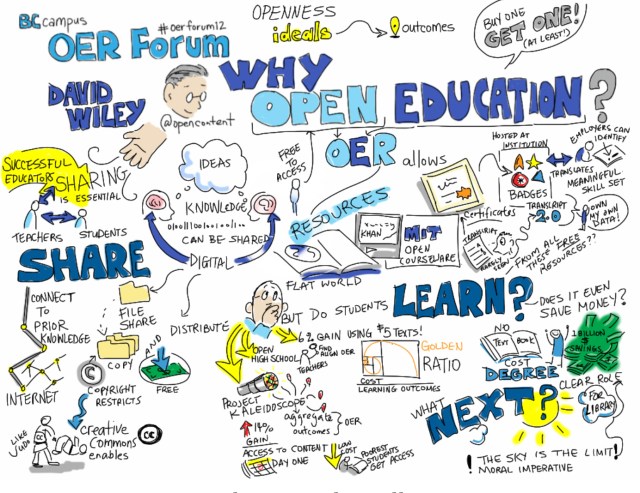
#LTHEchat No. 48. 09 March. Open Education Week special with Leo Havemann @leohavemann and Javiera Atenas @jatenas

Join Leo and Javiera between 8 and 9 pm on Wednesday 09 March.
If you are not yet sure about using Twitter you can follow the conversation here even if you do not have a Twitter account. You do need to make an account to respond to the tweets but it does only take a few minutes to do that.

Open Education
Leo Havemann and Javiera Atenas

This week #LTHEchat celebrates Open Education Week and considers how we can make openness easier to adopt. Open Education, comprising a series of practices and a variety of elements is almost a living entity, constantly changing, adapting and growing. Since Openness was first defined in the early 90’s the term has broadened in scope so that the open family has grown into open access, open science, open software, open licensing, open policies, open data, open repositories, open publishing, open courses and of course, open educational resources, and open educational practices.

The International Council for Open and Distance Education (ICDE) describes open educational practices as those practices that support the production, use and reuse of high quality Open Educational Resources (OER) through institutional policies, promoting innovative teaching models, and respecting and empowering students as co-producers of their own learning. Open education is about making knowledge available to anyone, anywhere, and supporting formal and informal learners.OE1

Why do we want, in the upcoming #LTHEchat, to talk about open education and its practices? Because we think that at the heart of open education is the people, the practitioners, the teachers, students and users, not OER; Open Access; Open Data; or Creative Commons. While these open movements have traditionally emphasised IP and licensing matters, these are not necessarily at the heart of what makes an open educator willing to share. However, these licenses are designed to support and enhance sharing and reuse, so this is an interesting game, where is necessary to shift the focus from the elements to the people.

OE

Giulia Forsythe   @bccampus #OERforum @opencontent Why Open Education?

Our intention is for participants to discuss your perceptions of openness in education, to understand how do you feel about and perceive these practices and how you use any of these elements in your practice. For us, openness and its elements are changing the teaching and learning landscape, but it is still unclear how or if are these becoming normal practice. So we look forward to your thoughts on the good, the bad and the ugly, about the benefits and challenges.

The storify is available here.

Posted in Uncategorized | 1 Comment

#LTHEchat No 47 02 March Dr. Sam Illingworth (@samillingworth ): Interdisciplinarity in HE learning and teaching

Interdisciplinarity is a an important construct in terms of advancing research and knowledge. Working with multidisciplinary teams allows for a sharing of expertise in a natural and meaningful way, but do we always do this in our teaching?

Do our universities allow for genuinely innovative interdisciplinary learning, and to what extent are our teaching practices putting our students into the same silos that we are hemmed into ourselves as teachers and learners? This Tweetchat aims to raise some of these issues, and by the very nature of the community will itself be a smorgasbord of interdisciplinarity.

If you are reflecting on this specific #LTHEchat in your blog or anywhere in social media please share your post with us so that we can reblog.

If you participated/are participating in any way in the #LTHEchat, please complete our short survey and let us know if you have other suggestions on how we could make the #LTHEchat more valuable for you. Thank you.

See you Wednesday, same time, same place 😉 – 8-9PM GMT Follow the hashtag and include it in your tweets to be part of the conversation #LTHEchat

The storify is available here.

The LTHEchat team
ps. If you would  like to become part of a future organising team, please get in touch with us via Twitter @LTHEchat 

Posted in Uncategorized | 2 Comments