
Join us on Wednesday 30th of September at 8.00pm (GMT/BST) with our guest contributor, Colum Cronin of Marino Institute of Education, Dublin, (@columfromcork.bsky.social). This #LTHEChat on BlueSky will explore how the design of time and space shapes student engagement, participation and belonging.
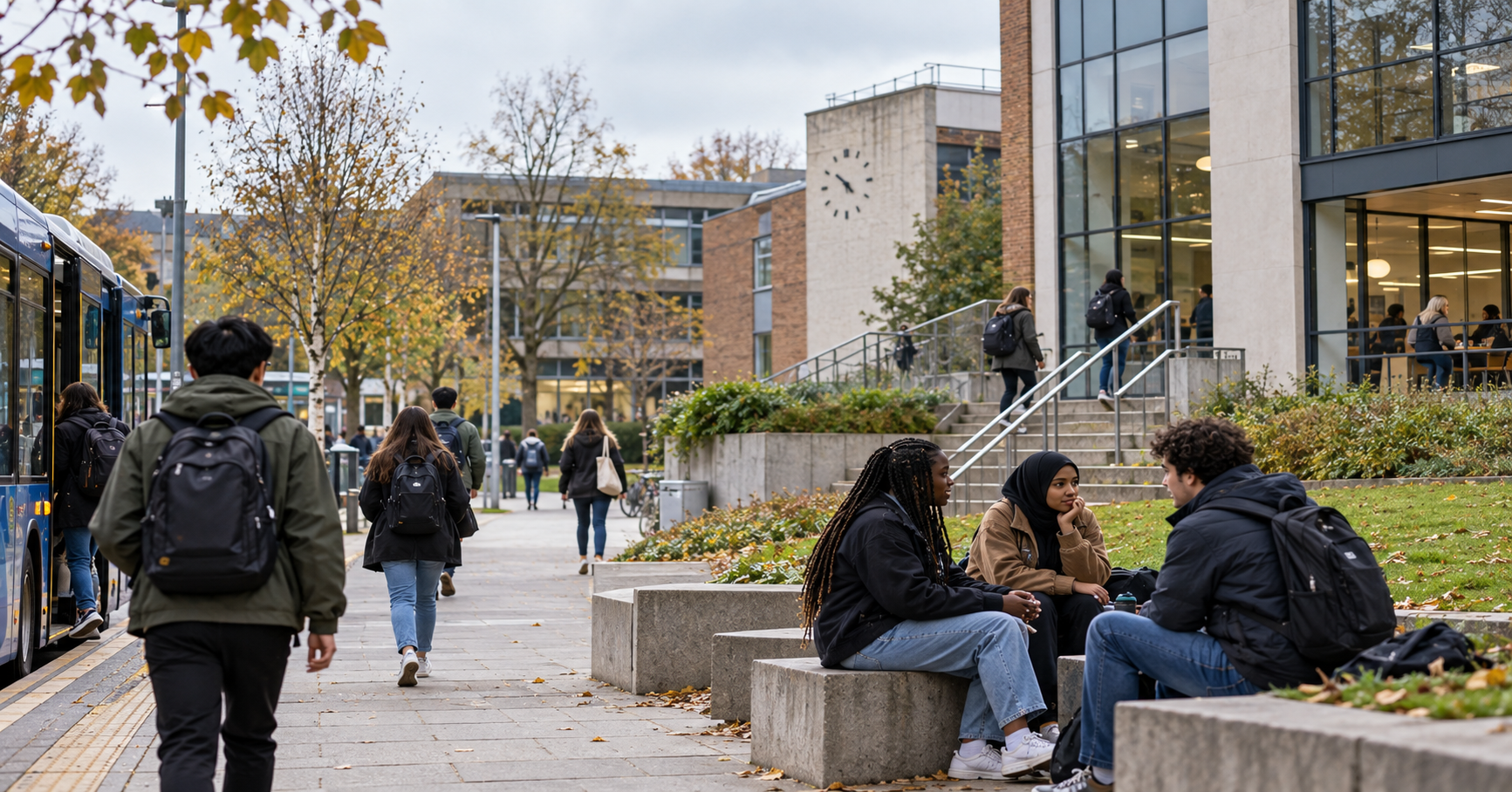
When students don’t engage, we tend to look at the student first. Why didn’t they come? Do they care enough? Are they motivated? But perhaps we are looking for reasons in the wrong place.
Before we ask what’s happening with the student, it might be worth looking at the architecture around them.
Not just the physical space, but the design of the experience: when something happens, where it happens, what else sits alongside it, how much time people have, what participation requires, and what the environment tells them is important.
Some students have lost interest, and no timetable will change that. In the UK, the proportion of undergraduates attending all their scheduled classes fell from 63% in 2006 to 48% in 2025 (Turner & Stephenson, 2026). It would be easy to read that as a generation that has stopped caring. Yet the same report finds that in-person contact is still central to a good experience.
So why aren’t they in the room? A Guardian callout asked students exactly that a couple of years ago (Otte, 2024). Many talked about paid work getting in the way. Others had worked out that with online lectures, they could watch recordings in less time than attending live and still get the grade without being there. One first-year student described how hard it was to make friends when “you don’t know who will show up”. We cannot control rising rents or the cost of living, which puts additional pressure on many students to prioritise paid work. A timetable that leaves no gaps for anything outside the classroom, alongside limited opportunities to meet people outside of their course group, or to engage with clubs and societies, includes elements of the academic architecture that we can influence. Students make choices, but they do so within a week we have designed.
“Hidden curriculum” usually makes people think of the unwritten rules of academic life, like how to email a lecturer or what office hours are actually for. I propose stretching it to include something more concrete: the timetable, the gaps between classes, the sequence of early experiences, and even the layout of the campus. We tend to treat these as administrative decisions, but they are signals that students read. The timetable teaches students whether their time is valued, whether connection is expected, and whether the institution sees them as members or as attendees. Together these elements make up what I think of as the hidden curriculum of time and space, the unspoken lessons students learn about their value and their place in the institution.
You see it most clearly with commuters. In Ireland, Eurostudent VIII found an average one-way journey time of 52 minutes for students living with their parents, compared with 17 minutes for those in student accommodation (Erskine and Harmon, 2023). Across a twelve-week semester, that difference is about 70 hours. In England, students travelling 45 minutes or more each way were more likely than others to report practical, academic and social problems, and to miss out on the wider student experience (Savanta, 2026). Add part-time work or caring responsibilities, and time on campus stops being elastic. It gets planned and rationed against bus schedules, train times, and lost shifts.
Some of that disconnection shows up as loneliness. Citing the work of Dr Gareth Hughes, Morgan and Gilani (2026) have recently argued that feeling lonely during a big transition is normal, and that universities should make connecting possible rather than treating student loneliness as a problem to fix. I agree. My argument isn’t really about loneliness. It’s about opportunity. A student cannot join a society whose meeting time clashes with the last bus home. We can’t shorten the bus route, but we do have some say over what happens in the middle of the day. Anything scheduled at the end of the day risks losing commuters who are already watching the clock. But there is something we can do in the middle of the day: create space for the incidental conversations that tend to get squeezed out by a full timetable. We can think about what happens between things, not just the things themselves. If a student travels 90 minutes to campus and then moves from one lecture to another with barely enough time to cross the building and find the next room, and with no break in which to talk to anyone, it becomes harder to argue that the journey was worthwhile.
Earlier this year, the Irish Government proposed asking institutions to examine whether classes could be condensed into fewer days to reduce commuting (Burne, 2026). At first glance, it sounds compassionate, and it would certainly mean less time on the road. But it raises a more interesting question: what are we asking students to come to campus for? If the campus is somewhere students mainly come for lectures and leave straight afterwards, fewer days may well look like a win. If it’s also where friendships form, societies meet, tutors become familiar faces and ideas get tested, fewer days mean fewer opportunities for those things to happen. We’ve invested heavily in student spaces and informal learning hubs, and I’m glad we have done so. But space without time is just furniture. More events won’t fix that if there are no gaps in the week to go to them.
At Marino Institute of Education, a small college of education in Dublin, we have tried to give some of that time back to students. Every Tuesday and Wednesday, the period from noon to 1pm is protected across all undergraduate programmes as Student Life Hour. Positioned in the middle of the day, with lunch straight after, this simple change offers a predictable two-hour window twice a week to make their own. Instead of another engagement initiative, we created space and time in which engagement could happen. We simply stopped timetabling during those hours, which signalled that being on campus outside class was legitimate, and left the choice to students. As one first-year student put it, “It is on my timetable, so I can stay.” They might study or meet a friend for coffee. Clubs and societies use it too, and some that had struggled with attendance have started running regular events. Our Neurodiversity Group started meeting weekly during that hour, something an evening slot would have put out of reach for commuters. Tutors started running into students in communal spaces, and conversations that used to need an appointment just happened. And we’re seeing the knock-on effects in the broader college community. I’ve written more about this, and a couple of other changes, in Waypoint (Cronin, 2026).
None of this is an argument for stringent compulsory attendance or against supportive approaches like lecture capture. Flexibility is what makes study possible at all for some students. I don’t have a good answer to what the equivalent of the corridor conversation looks like for students who are rarely or never on campus, and I’d like to hear from the people who design for them.
The question I’d like to bring to Wednesday is what conditions we have actually created for engagement to happen. My hunch is that much of what we call apathy may be students reading the week we’ve built for them and making sensible decisions.
Questions
1. Think back to when you were a student. Where did the conversations that mattered most happen?
4. If a student travels an hour each way, what would make the day worth the journey?
References
Burne, L. (2026) ‘Accommodation crisis: Colleges to be asked to cut number of days students must be on campus’, Irish Examiner, 23 February.
Cronin, C. (2026) ‘The hidden curriculum of time and space: why belonging is designed before it is felt’,, Waypoint: A Reflective Journal of Student Advising and Development in Tertiary Education, 3, Available at: https://journal.ukat.ac.uk/waypoint/article/view/23,
Cullinan, J., & Flannery, D. (2026). ‘Commuting and college student wellbeing’. Education Economics, 34(5), 674–693.
Erskine, S. and Harmon, D. (2023) Eurostudent Survey VIII: Report on the Social and Living Conditions of Higher Education Students in Ireland 2022. Dublin: Higher Education Authority.
Morgan, M. and Gilani, D. (2026) ‘Part Two: From loneliness to belonging: what can universities actually do?’, HEPI Blog, 20 September.
Otte, J. (2024) ‘”I see little point”: UK university students on why attendance has plummeted’, The Guardian, 28 May.
Savanta (2026) Experiences and Risk Among Commuter Students in Higher Education. Survey for the Office for Students, 28 July.
Turner, G. and Stephenson, R. (2026) What Matters Most? 20 Years of the Student Experience. HEPI Report 200. Oxford: Higher Education Policy Institute.
Bio

Originally from Cork and based in Dublin, Colum Cronin is Student Engagement Officer at Marino Institute of Education and co-lead of the Centre for Belonging in Education. He has more than twenty years of experience across Irish higher education, with previous roles at DCU, UCD and Trinity College Dublin focused mainly on international students, and is a former board member of the Irish Council for International Students. He is currently an EdD candidate at DCU, researching the hidden curriculum of time, space and agency in student transitions.
His work starts from the idea that belonging is designed long before it is felt, and that disengagement is far more often a problem of architecture than of apathy. An award-winning podcaster and presenter, he can be found across social media @columfromcork


I love timetabling student time! As your student said: It’s on mtytimetable… In this hectic too busy, employability driven HE, we need to give permission to students to dally awhile. My wish is for an accredited module focused on engaging with the SU, joining a Club, setting up a Society. Our ‘non-trad’ students especially need ‘permission’ to enter these powerful university spaces.
LikeLike