
Join us on Wednesday 7th of October at 8.00pm (GMT/BST) with our guest contributor, Catherine O’Mahony, University College Cork, (@catherineomahony.bsky.social). This #LTHEChat on BlueSky will explore dual coding and visualising thinking.
Introduction
Dual coding theory suggests that learners process information through two linked channels: a verbal and a visual system. When the same idea is presented in both forms, learners more readily encode that information in long term memory.
In practice, this means pairing explanations with meaningful visuals such as diagrams, timelines, flowcharts, concept maps, or annotated sketches.
When we design teaching in such a way we lessen the cognitive load of encoding new information in long term memory as we lessen the likelihood of either the visual or auditory sensory channels being overloaded.
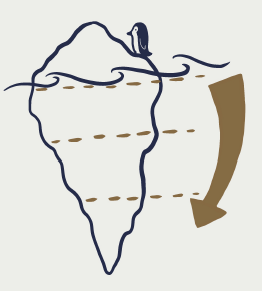
Visual metaphors are commonly used to help students understand complex concepts. Equally, visual activities can be used to make learning more active, to make thinking visible, and surface new connections. For example, the Iceberg Model is a systems thinking tool to help students look past surface problems to find hidden root causes.
We can also model retrieval practice through visual methods by encouraging students to create concept maps or timelines to reveal their understanding and strengthen their retention of concepts and information.
Visual methods can enable students to share aspects of their cultural background. For example, conversations flow when students see photographs of babies in Scandinavian countries sound asleep in snow covered streets outside cafes. Graphic jams, where students create rapid fire drawing in response to one word prompts, can uncover cultural norms around the value of education, economic models etc.
Visualising thinking should not be at the expense of accessibility. Using alt-tags for images or narrating slides and visual prompts all help as will sharing resources ahead of any live event.
Resources
1. Visualising thinking www.youtube.com/watch?v=425QeUuXqrs
This 3 minute video summarises cognitive load theory and dual coding, and considers the implications for teaching and learning.
2. This short resource on “More engaging teaching through visualising thinking“, was created with graphic harvester Maia Thomas following on from a series of on-site and on-line workshops we ran on visualising thinking for Higher Education staff. It provides suggestions on how to run create similar learning activities with staff and students as well as some disciplinary examples www.ucc.ie/en/media/support/cirtl/ResourcesforStaff_VisualisingThinking.pdf
3. In this podcast the Learning Scientists explore the final of 6 strategies for effective learning, dual coding
www.learningscientists.org/learning-scientists-podcast/2018/2/7/episode-12-dual-coding
4: Website designed to support the development of visual, spatial and tactile knowledge and skills in any discipline https://blogs.brighton.ac.uk/visuallearning/
5: Student blog on the experience of visual note taking
https://noblechloe.wordpress.com/first-year-learning-logs/visual-notes/
6: A Periodic Table of Visualization Methods
Biography
Dr Catherine O’Mahony (she/her) leads the Centre for the Integration of Research, Teaching and Learning at University College Cork, Cork, Ireland. As Director, she sets the strategic vision for professional development in teaching and learning across the university. Over the years she has led institutional, national and international projects on topics ranging from student engagement and sustainability education to undergraduate research, inclusive practice, and educational leadership.
Most recently she has implemented a cross-campus curriculum change initiative, is leading work on innovative teaching and mobilities for the UNIC European University Alliance, a partnership of nine higher education institutions, and has co-developed a national professional recognition framework for teaching and learning with educational leaders in Irish Higher Education. She serves as Co-Principal Investigator on STAFF-DEV, an Erasmus+ funded project led by the European University Association focused on staff development in teaching and learning, alongside a broader portfolio of research activities.
Questions


