
Academic challenge is an essential part of higher education. However, challenging students should not mean leaving them to struggle without support. The aim is to create learning environments where students feel confident and equipped to navigate difficulty while developing their academic capabilities.
In a recent CPD workshop on Academic Challenge and Supporting Students to Cope at The University of Law, we explored how educators can maintain high expectations while helping students respond constructively to academic challenges.
Challenge and support go hand in hand
Meaningful learning often involves encountering unfamiliar concepts, questioning assumptions and developing new skills. Vygotsky’s (1978) Zone of Proximal Development reminds us that learning can be enhanced when students are appropriately challenged and supported through scaffolding.
However, students may interpret academic difficulty as evidence that they lack ability or do not belong in higher education. Research on belonging (Walton and Cohen, 2011) and Self-Determination Theory (Ryan and Deci, 2000) highlights the importance of fostering students’ sense of competence, connection and confidence.
The solution is not necessarily to reduce academic challenge, but to ensure students have the support to navigate it.
A simple three-stage approach
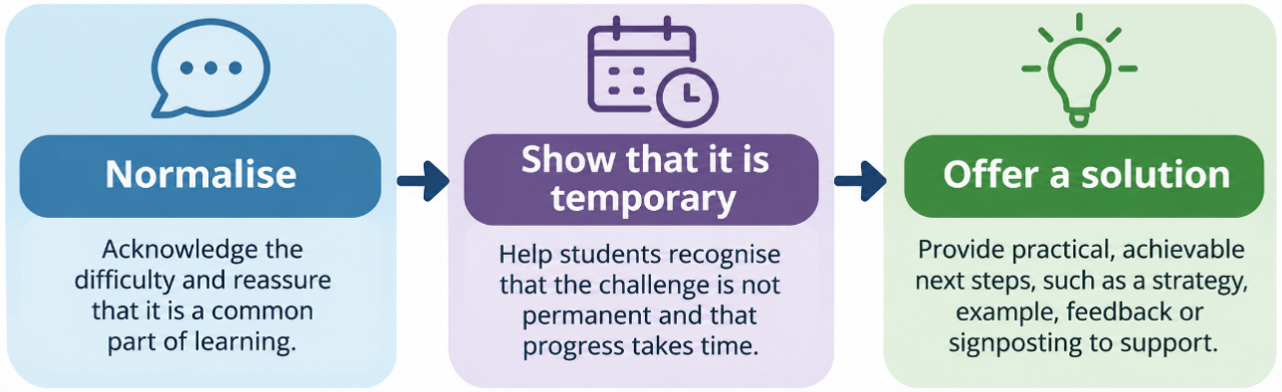
One practical strategy explored during the workshop was:
(Image generated by GenAI)
This approach encourages educators to acknowledge students’ difficulties, help them recognise that their current challenges need not be permanent and provide practical strategies for moving forward.
For example, imagine a First-year undergraduate student struggling with critical analysis:
1. Normalise: “Many students find critical analysis challenging, particularly when transitioning into higher education. It is a skill that takes time to develop.”
2. Show that it is temporary: “You are not expected to master this immediately. With practice and feedback, your ability to evaluate arguments and evidence can improve.”
3. Offer a solution: “Let’s compare two authors’ perspectives, identify their arguments and examine the evidence they use. You can then apply this approach to your own reading.”
This approach reflects the importance of helping students develop more constructive interpretations of academic setbacks (Dweck and Leggett, 1988), while ensuring reassurance is accompanied by meaningful pedagogical support.
Creating the conditions for success
Not all difficulties are educationally beneficial. Bjork and Bjork (2011) suggest that certain challenges can strengthen learning, but difficulties must serve a meaningful purpose.
As educators, we should therefore consider whether our teaching provides appropriate scaffolding, transparent expectations and opportunities for students to develop confidence through practice and feedback.
Ultimately, the question is not simply ‘Are we challenging our students enough?’ but ‘Are we creating the conditions in which students can respond successfully to academic challenge?’
By normalising difficulty, emphasising its potentially temporary nature and offering practical solutions, we can maintain academic standards while supporting students to develop as confident, capable and increasingly independent learners.
References
Bjork, E.L. and Bjork, R.A. (2011) ‘Making things hard on yourself, but in a good way: Creating desirable difficulties to enhance learning’, in Gernsbacher, M.A., Pew, R.W., Hough, L.M. and Pomerantz, J.R. (eds.) Psychology and the real world: Essays illustrating fundamental contributions to society. New York: Worth Publishers, pp. 56–64.
Dweck, C.S. and Leggett, E.L. (1988) ‘A social-cognitive approach to motivation and personality’, Psychological Review, 95(2), pp. 256–273.
Ryan, R.M. and Deci, E.L. (2000) ‘Self-determination theory and the facilitation of intrinsic motivation, social development, and well-being’, American Psychologist, 55(1), pp. 68–78.
Vygotsky, L.S. (1978) Mind in society: The development of higher psychological processes. Cambridge, MA: Harvard University Press.
Walton, G.M. and Cohen, G.L. (2011) ‘A brief social-belonging intervention improves academic and health outcomes of minority students’, Science, 331(6023), pp. 1447–1451.

Dr Chris Martin (LTHEchat Mentor) is an Academic Developer at the University of Law where he is Professional Practice Lead within the Academic Development and Research Team. He oversees the institution’s AdvanceHE Fellowship Scheme alongside supporting academic colleagues’ professional development as well as contributing to the PGCHE/PGDip/MA in Education. Chris’ is a Chartered Psychologist and Associate Fellow of the British Psychological Society. His research explores the application of psychological theories to learning and learning contexts, particularly theories of motivation (Self-Determination Theory and Expectancy-Value Theory). He is also a Fellow of SEDA and sits on the SEDA Fellowship Committee in addition to mentoring on the FSEDA programme. You can learn more about Chris on LinkedIn or talk with him on Bluesky@drchrism.bsky.social or by email at chris.martin@law.ac.uk


