#LTHEchat 163: The Role of Curriculum Frameworks in Higher Education with Adam Longcroft @AdamL50 and Iain Cross @iain_d_cross

The changing UK higher education landscape

The last decade has seen rapid and dramatic changes in the higher education landscape in the UK. The lifting of the ‘cap’ on student numbers led to increased competition between higher education institutions (HEIs) and the influence of new market forces, whilst the introduction of the OfS has seen the replacement of a relatively benign funding body, with a new sector regulator.

Student numbers have increased rapidly resulting in the ‘massification’ of the HE sector, and fundamental changes in the make-up of the student body in most HEIs. Despite this there is intense competition to recruit students, and HEIs are opening their programmes to more diverse and non-traditional cohorts than ever before. Student support services and resources have had to be reconfigured, and academic programme teams have had to adapt their pedagogies accordingly. Previous quality audits of research have evolved into the now familiar REF, but we have also seen the introduction of the TEF, and more recently the KEF.

What may have seemed like stability has been replaced by a culture of what sometimes feels like an avalanche of rapid and fundamental changes, some of which impinge on the financial sustainability of institutions and some of which have driven major cultural changes – not least a rapid shift in student expectations of the higher education experience, and the relationship between institutions and their students. The relative strengths and performance of HEIs is now more transparent than ever, and reflected (however crudely) via published university league tables, NSS results and TEF rankings.

How have institutions responded?

Faced with these external and internal changes many HEIs have responded by reviewing the structure and organisation of their taught programmes at undergraduate or post-graduate level (or both). In some cases this process has been driven by a perceived need to reduce complexity and unnecessary ‘variance’ in the design or delivery of programmes, or by a need to reduce costs and achieve improved efficiencies in delivery.

In others, the development of new approaches to either structure or delivery has been deliberately focused around existing institutional strengths, such as the perceived ‘nexus’ where research and teaching intersect. Many HEIs have well-established and highly visible ‘Graduate Attributes’, and these have either been designed in tandem with new Curriculum Frameworks or have driven an enhanced subsequent focus on consistency in the design and/or delivery of programmes to enable these to be achieved.

A renewed focus on ‘teaching excellence’ or ‘student outcomes’ – driven in part by the NSS and the TEF – has also resulted in some institutions focussing more on ‘pedagogy’ and/or ‘student literacies’. A defining feature of many new Curriculum Frameworks is the inclusion of such literacies.

The emergence of Curriculum Frameworks

The growing recognition in the sector of the importance of defining or articulating institutional ‘distinctiveness’ in the design and delivery of programmes, and the approach taken to supporting effective learning, is reflected – at least in part – in the emergence of ambitious and often highly innovative Curriculum Frameworks of various forms.

One of the best know is the ‘Connected Curriculum’ at UCL, which focuses on the centrality of the power of research and way this informs both teaching and student learning. Now well-established, the Connected Curriculum provides UCL with a highly distinctive USP. At Anglia Ruskin University (ARU), the emergence of the ‘Active Curriculum Framework’ places a set of ‘powerful pedagogies’ and ‘student literacies’ centre-stage, with new ‘breadth modules’ (Ruskin Modules) providing students with new opportunities to step outside their particular specialism and engage with a broader curriculum.

At the University of East Anglia (UEA), the development of the ‘New Academic Model’ between 2010 and 2015 constituted an ambitious series of regulatory changes that placed a renewed focus on setting high expectations for students and ensuring greater consistency in programme design.  Similarly, the University of Sunderland’s ‘Integrated Curriculum Design Framework’ claims to “bring together, for the first time, various key policy drivers such as embedding graduate attributes, promoting employability and developing an inclusive curriculum which enhances the student experience”. Other similar Curriculum Frameworks include those at Reading University, the University of Portsmouth, which has a set of ‘hallmarks’ that courses have to be aligned with, and the Inclusive Curriculum Framework at Kingston University, which ensures that “the principles of inclusivity are embedded within all aspects of the academic cycle from the development and revitalisation of curricula, through the practice of teaching and learning, to the process of assessment and finally full circle to programme review, modification and revalidation”.

At St Mary’s University, Twickenham, we have been involved in leading, with students and staff, the design of a new Curriculum Framework (see figure below) which focuses on a more consistent and coordinated approach to learning and teaching (via an agreed set of ‘Effective Teaching Practices’ and ‘Student Literacies’) and the delivery of a new set of ‘Soft Skills’, ‘Practical Skills’, ‘Graduate Qualities’ (values) and ‘Graduate Attributes’.
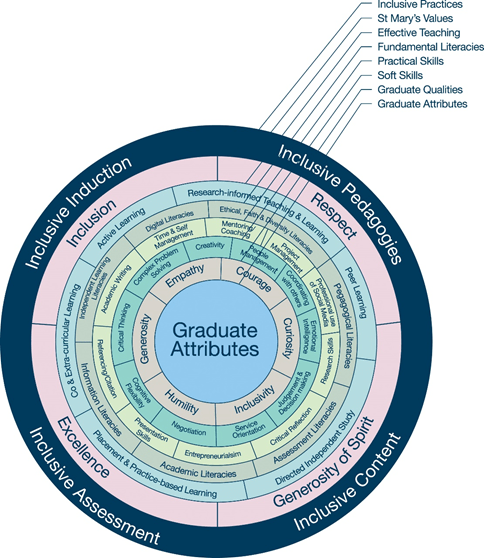
Curriculum Framework  for St Mary's University, Twickenham.
Curriculum Framework for St Mary’s University, Twickenham (used with permission of the guest hosts)

This new framework  includes a strong emphasis on inclusive approaches to teaching and assessment, the creation of a new set of ‘Champion’ roles embedded in Faculties (for Employability, and Diversity and Inclusion), and interdisciplinary ‘breadth modules’ which allow students new opportunities to study outside the comfort zone of their own discipline at Level 5 and 6.

The challenges of Curriculum Frameworks

Of course, proponents of disciplinary variance and academic autonomy might argue that establishing an institutional-level Curriculum Framework or over-arching structural constraints of any kind constitutes an unnecessary and, indeed, undesirable objective that inhibits creativity and academic freedoms. This is a legitimate concern and one of which those involved in developing or championing Curriculum Frameworks need to be mindful.The reality, of course, is that in most HEIs academic programme teams already have to design and deliver their programmes within various pre-existing expectations and regulations (which are in turn normally strongly in formed by sector framework documents such as the Framework for Higher Education Qualifications (FHEQ) and a panoply of other QAA documents), and also – crucially – the QAA subject benchmarks. Some may also have to align to pedagogic and content guidelines and advice given by professional, statutory and regulatory bodies (PRSBs). Even so, any Curriculum Framework is likely to be unsuccessful unless these concerns are confronted early on and overcome through extensive consultation and debate.

Missed the chat?

Follow the conversation here

https://wke.lt/w/s/tP3N0X

About this week’s hosts

Dr Adam Longcroft

Dr Adam Longcroft is the Head of the Centre for Teaching Excellence & Student Success at St Mary’s. He began his academic career as an Academic Director in Continuing Education at the University of East Anglia (UEA) in 1995. He went on to serve as Teaching Director in the School of Education at UEA, and the University’s Director of Taught Programmes between 2011 and 2016. In the latter role he was involved I leading the development and implementation of UEA’s ‘New Academic Model’ – a University-wide initiative focused on streamlining the structure and regulations relating to the University’s undergraduate and post-graduate programmes. He subsequently led the design and initial roll-out of Anglia Ruskin University’s new ‘Active Curriculum’ between 2016-18 as the Deputy Head of Anglia Learning & Teaching, and was more recently appointed as the inaugural Dean of Learning & Teaching at St Mary’s University in Twickenham. In this role he has led the development of a new undergraduate Curriculum Framework which is now being implemented across the University. Adam is a National Teaching Fellow (2007) and a Principal Fellow (2015) of the Higher Education Academy (now AdvanceHE).

Dr Iain Cross


Dr Iain Cross is the Associate Dean for Learning and Teaching in the Centre for Teaching Excellence and Student Success at St Mary’s. He works with the Associate Deans in the Faculties and the CTESS team on a range of learning and teaching enhancement projects. He joined St Mary’s in 2011 as Visiting Lecturer in Physical Geography, and has since held positions as Programme Director for Geography and Academic Director for Teaching and Leaning Quality and Enhancement. He has particular interests in technology enhanced learning, and using virtual reality in education. He is currently researching climate change teaching in higher education. In addition to leading continuing professional development of academic staff, Iain has been instrumental in developing a new Personal Tutor Dashboard at St Mary’s and is playing a key role in implementing a new student record system at St Marys. He is a Senior Fellow of the Higher Education Academy.

A Wakelet of this chat will be posted as soon as possible after the event.

Posted in announcement | Tagged , , , , | 1 Comment

#LTHEchat 162: ‘Playful Learning Technologies’ with Katie Piatt @katiepiatt facilitated by Rachelle O’Brien @rachelleebrien

Katie has previously led an LTHEchat on Playful learning experiences (https://lthechat.com/2017/12/03/lthechat-98-engagement-through-playful-learning-experiences-with-katie-piatt-katiepiatt-and-fiona-macneill-fmacneill/) – but tonight we are thinking about how we can use technology in a playful way and not just the easy things (like a Kahoot) but making the VLE, webinars and things like Microsoft Teams more playful too.

Firstly though, what do we mean by Playful Learning? We’re talking about activities and approaches to learning that start with a spirit of playfulness: this might be by using tools or games, but most importantly finding different ways of doing things to create a safe space for learners to take risks, to try and fail and importantly, for learners and teachers alike to become open to new possibilities.

It seems that, despite our best intentions, the most common use of a Virtual Learning Environment (VLE) such as Blackboard, Moodle and Canvas is to upload files or links into a series of folders. I have observed very few examples where educators add playfulness to their VLE content. 

This weeks tweetchat looks to collate real examples that have worked for participants and a chance to reflect on the value of making things more playful.

Biography

Katie Piatt is the elearning manager at the University of Brighton.  Katie has a real passion for technology and how it can make teaching more effective – working with her team to support staff across the university to provide a better teaching and learning experience. Katie is co-Chair of the Playful Learning Association (http://pla.playthinklearn.net/) and loves being able to introduce techniques and tools to make learning more fun and engaging. If you’ve ever seen Katie present, there was probably a quiz involved! 

Photo of Rachelle O'Brien

Rachelle O’Brien is an Educational Developer at University of Liverpool Centre for Innovation in Education. Rachelle is passionate about digital education and providing equal learning opportunities for all. With interests in psychology, games and play in education, Rachelle can often be found using innovative techniques to encourage staff and students to think differently about difficult concepts. These include game creation, escape rooms and the use of Lego to name just a few. Her blog can be found here: https://rachelleeobrien.wordpress.com/

Posted in announcement | Tagged , , , , , | Leave a comment

#LTHEchat 161: ‘Social Media in HE’ with Chris Rowell @chri5rowell

Social media isn’t the ‘new kid on the block’ anymore, it is part of the mainstream of university life. It’s been around for more than a decade now and most staff and students have engaged with at least one of the major platforms , such as Twitter, Whatsapp, Instagram, Facebook, LinkedIn or Snapchat (Carrigan, 2019) Social media affects the lives of staff and students in a number of ways. It can help build networks both within and across universities. Blogs and twitter enable academics, researchers, librarians and support staff to meet like-minded people , who go on to share ideas, promote their research and collaborate together. Social media can also be a source of continuing professional development, Twitterchats like #LTHEchat are a great example of this type of activity. The use of social media in teaching and learning has led to some great examples and experiments in innovative practice. Social media is now seen as an important graduate skill that needs to be embedded into the curriculum to prepare graduates for the workplace (Rowell, 2019). However, it also clear that the use of social media has a downside too. Examples of harassment and trolling are now are now being reported by both staff and students. This week’s #LTHEchat is designed to provide us with the chance to reflect and be critical about the pros and cons of social media. Is it just a distraction for busy academics? Are we controlling the ‘Twittering machine’ or is it controlling us? (Seymour, 2019) Do universities provide enough support for their staff and students. Is more training the answer? Join us at #LTHEchat to share your experiences and have your say. Carrigan, M. (2019). Social Media for Academics.

London: Sage Publications. Rowell, C. (ed) (2019) Social Media in Higher Education: Case Studies, Reflections and Analysis. Cambridge, UK: Open Book Publishing. Seymour, R. (2019). The Twittering Machine. London: The Indigo Press.

This weeks wakelet can be found here https://wke.lt/w/s/rzyNI9

Biography:

Hi my name is Chris Rowell and I am a Academic Developer in Digital Enhanced Learning at London South Bank University.  Previously I was  Learning Technology Manager at Regent’s University in London,  a Lecturer in Economics (1990- 2005) and a Lecturer in Education (2005-2010) at the University Centre Croydon.
My first degree (BA Hons) is in Economics. I have a PGCE  and I also have two MA’s in Development Studies and Education (eLearning). More recently I have completed Prince2 training for project management. Currently I am doing a Doctorate in Education at the Institute of Education, UCL.
My research interests are all things to do with Technology Enhanced Learning (TEL). More specifically the use and evaluation of social media by staff and students in Higher Education.
Currently, I am an editor of the Association for Learning Technology’s (ALT)  blog and journal ‘Research in Learning Technology’.  Previously I have been a  member of the Staff and Educational Development Association’s (SEDA) National Executive (2015-10)  and Conference Committee (2010-1015) and founding member SEDA’s Special Interest Group on Technology-Enhanced Practice. I am also a Certified Member of the Association for Learning Technology (CMALT).
I live in Camberwell and I’m interested in things to do with cycling, photography, travel, politics and London.

chris.rowell@hotmail.co.uk

https://www.youtube.com/channel/UCYVEie_o1yxl0vwHNeT114w

@chri5rowell

Image of Chris Rowell

Posted in announcement | Tagged , , , | Leave a comment

#LTHEchat 160: ‘Teaching Ethics’ with Dr Helen Kara @DrHelenKara

Ethics is a hot topic in higher education (HE), touching many areas from fake news to trigger warnings, mass shootings to individual cases of abuse or discrimination. Yet ethics as a subject is often seen as dry and boring. It is only taught as a specific topic within a few disciplines, such as philosophy and religion, although research methods – and, therefore, research ethics – feature in many courses. However, research ethics in HE is primarily a regulatory system requiring students to fill in forms to please a committee, rather than an educational system teaching students to think their way through the ethical dilemmas that they will encounter in their studies and beyond.

In this complex environment, Helen will lead us to consider (via the chat) how educators can best use and create opportunities to raise ethical awareness, and what can help them in that work.

Biography:

Dr Helen Kara has been an independent researcher since 1999 and also teaches research methods and ethics. She is not, and never has been, an academic, though she has learned to speak the language. In 2015, Helen was the first fully independent researcher to be conferred as a Fellow of the Academy of Social Sciences. She is also an Honorary Senior Research Fellow at the Cathie Marsh Institute for Social Research, University of Manchester. She has written several books and journal articles on research methods and ethics, including Research Ethics in the Real World (2018, Policy Press), and regularly writes about ethics on her blog.

Dr Helen Kara

The Wakelet will be shared here following the chat.

Posted in Uncategorized | Tagged | Leave a comment

#LTHEchat 159 Contract Cheating with Dr Thomas Lancaster @DrLancaster

How should we address contract cheating in higher education? Contract cheating has been an area of personal interest to me since Robert Clarke and I published the first paper referring to this type of academic misconduct back in 2006.

Even back in 2006, we could see the start of an industry being built designed simply to help students to get qualifications that they do not deserve. Left largely unchallenged, we’re now seeing an industry with an annual turnover thought to be in the hundreds of millions of pounds and which is keeping thousands of individuals in employment. Much of my recent research has focused on the individuals and providers behind contract cheating services, demonstrating that there is no shortage of supply or demand.

This week’s #LTHEchat is designed to provide us with the chance to reflect on where we are as a sector in addressing contract cheating, to discuss the positive steps that have been taken, to look at the initiatives that are working and also to map out what more we still have to do. Contract cheating is not a challenge which can be solved through a single approach or by people requiring in isolation. It requires sector wide effort.

At the same time as we make changes, we also have to be mindful of the unintended ethical consequences of the decisions we make. Is it fair to put individuals out of work who rely on selling essays to feed their family? Is it right to be considering laws which could lead to parents being imprisoned for completing the homework of their children? But, perhaps more importantly, is it even more unethical and unfair to our students to sit back and do nothing about contract cheating?

Join us at #LTHEchat to share your experiences and have your say.

The Wakelet for this chat is #LTHEChat 159.

Biography

Dr Thomas Lancaster

Dr Thomas Lancaster is a Senior Teaching Fellow in the Department of Computing at Imperial College London. He has researched into plagiarism, contract cheating and academic integrity since 2000, working at and alongside a variety of universities in the UK and internationally, as well as with sector bodies such as the Quality Assurance Agency. He regularly discusses these areas with the media. He is a member of the organising committee for the International Day of Action against Contract Cheating and is a keynote speaker for Plagiarism Across Europe and Beyond 2020. His recent publications have explored the operation of the academic writing industry, including the providers from Kenya and India operating in the gig economy, as well as how Twitter is being widely used to being used to connect together student buyers and contract cheating providers.

Website: http://www.thomaslancaster.co.uk

Twitter: https://twitter.com/DrLancaster

Linked: http://linkedin.com/in/thomaslancaster

Posted in announcement | Tagged , , | Leave a comment

#LTHEchat 158 ‘The Emerging Field of Learning Development’ with Dr Helen Webster @scholastic_rat and Dr Kim Shahabudin @kimshahabudin

This week’s discussion focusses on the emerging field of Learning Development in the context of significant changes in Higher Education (HE). These changes are being brought about by the Widening Participation agenda, increasing internationalisation, massification and marketisation of HE and drivers such as inclusivity, accessibility and student-centred teaching.

Because of these developments, the student body is more diverse than ever before, with concomitant concerns that it is also less prepared for university level study than before, and unease about access and attainment gaps.

Learning developers have a remit which is often called ‘study skills’ or ‘academic literacies’. They work with university students to help them make sense of and negotiate academic practices in HE and develop as successful, independent learners. What learning development is, is still the subject of lively debate: is it a profession, a community of practice, a discipline, a pedagogy, or a field? For many of us, at its most fundamental level, it’s our job.

Learning Developers may hold any one of a number of job titles (study adviser, academic skills coach, learning enhancement tutor etc); they may be embedded in schools and faculties, or located in central contexts such as student services, libraries, learning and teaching services or English for Academic purposes, or may have a Learning Development function as part of a wider role, such as subject lecturer. Their remit may include just academic writing, or wider ‘learning to learn’, and they can find themselves doing one-to-one tutorials, central workshops, embedded sessions, online resources or, like their Educational Development colleagues, working with academic colleagues to develop this aspect of the curriculum. Their backgrounds and expertise may be similarly diverse.

This week Helen and Kim lead us to consider what it might mean to teach study skills effectively and how staff in all learning, teaching and student support roles, as well as students themselves, might work with Learning Developers in this emerging field.

Biographies

Dr Helen Webster is a Learning Developer and Head of the Writing Development Centre at Newcastle University. She works in a central, student-facing role across the institution, helping students at all levels and in all disciplines negotiate the complex conventions and practices of UK Higher Education, and reflect on their own study strategies to become successful independent learners.

She is interested in developing interprofessional models and approaches for this emerging profession, particularly around one-to-one work. A qualified teacher, National Teaching Fellow (2019), Senior Fellow of the HEA and Certified Leading Practitioner of Learning Development, she is also an executive steering group member for the Association of Learning Developers in Higher Education. She blogs at https://rattusscholasticus.wordpress.com

A photo of Dr Helen Webster

Dr Kim Shahabudin has been a learning developer since 2006, working with the Study Advice team at the University of Reading until June 2019, and more recently as a sessional tutor for Oxford University’s Dept of Continuing Education. She was a member of the LearnHigher CETL from 2006-2010, and has served on the steering group for the Association for Learning Development in Higher Education.

Kim’s research interests are in teaching student referencing practices, support for mature students, and mediating successful transitions to higher education. She also has an interest in developing models and defining values for the emerging learning development profession. She holds Senior Fellowship of the HEA and Certified Leading Practitioner of Learning Development status. In 2018, she was awarded a University Teaching Award by the University of Reading. She retains the title of the only learning developer to be portrayed on an exhibit in the Victoria and Albert Museum.

A photo of Dr Kim Shahabudin

The Wakelet, created the morning following the #LTHEchat, is available at https://wke.lt/w/s/d1jnzB

Posted in announcement | Tagged | 1 Comment

#LTHEchat 157 A Proposal for a Sector-wide Framework for Personal Tutoring in HE with Ben Walker @benwwalker1

The Higher Education Research Act established a regulatory framework and the Teaching Excellence Framework with associated metrics for student retention, progression and employability.  In meeting these requirements, the significance of personal tutoring is clear. Despite this, according to existing institutional research, there is a need for developmental support, greater clarification on the requisite competencies, and adequate recognition for those undertaking this challenging role.  Moreover, arguably compounding these concerns is the lack of distinct professional standards for personal tutoring and advising against which to measure effective practice. This research draws on data gathered from a survey of practitioners designed to determine the demand for national personal tutoring standards, identify the competencies which may populate them, and determine the recognition with which they could be associated.  Additionally, it evaluates the relevance, adequacy and usefulness of existing standards such as the UK Professional Standards Framework for Teaching and Supporting Learning in HE. Important findings include a significant demand for a set of specific standards for personal tutoring and advising. Justifications provided for this and the opposing view are examined. Clarity for both individual practitioners and institutions was stipulated along with meaningful recognition and reward for this work which is considered highly important and yet ‘invisible’.  The surveyed professionals in the field identified relevant potential content along with illuminating the debate about the relationships between personal tutoring, teaching and professional advising roles. Valuable critical analysis of standards, recognition and reward also emerged. This is considered by discussing the connection between standards and changes to practice, responses to policy developments and the purpose of ‘standards’ in comparison to ‘guidance’.

In this chat, Ben will lead a discussion of the proposition that the introduction of bespoke standards is a necessary response to alleviate some of the current tensions which beset personal tutoring and advising in higher education.

The Wakelet for this chat is #LTHEChat 157.

Ben Walker

Ben Walker

Ben is a Senior Lecturer in Academic Development at Manchester Metropolitan University (MMU) and Senior Lecturer in Teacher Education (HE) at the University of Derby.  As Vice-Chair of the UK Advising and Tutoring association (UKAT), he has responsibility for professional development in this organisation which is the sectoral voice and lead for personal tutors and academic advisors.  He is co-author of the highly regarded Effective Personal Tutoring in Higher Education which includes a foreword by Professor Liz Thomas, the author of the What Works? reports, seminal works on student retention and success.  Previously, Ben undertook higher education research at the University of Lincoln and was a teacher educator within college-based higher education in partnership with Sheffield Hallam University. Going further back, he was Head of English and a full-time teacher of English for several years.  He was the originator of UKAT’s current national webinar series, Tutoring Matters. His doctoral research is focussed on academic and pastoral support of students informed by critical pedagogy. He also happens to be a drummer in a Sheffield indie band… A keen writer and researcher within education, Ben is passionate about the impact the support side of a lecturer’s role, including personal tutoring and coaching, can have on students individually, as well as institutions more broadly, and I am committed to developing this field further.  You can find out more about Ben’s work at www.benwwalker.co.uk.

Posted in announcement | Tagged , , | Leave a comment

#LTHEchat 156 ’Simulation as an assessment tool to promote authentic learning in Higher Education’ with Gustavo Espinoza Ramos @tavoer8

Authentic assessment

The traditional forms of assessment are based on conventional methods of testing that usually involves the production of written document including tests, essays and reports; and follow the transmission of knowledge from teacher to learner that creates a passive learning atmosphere (Herrington and Herrington, 2006). The criticism of this assessment rests upon the level of knowledge and transferable skills that can be applied in other contexts and it does not meet the needs of a “dynamic and changing workforce” (Herrington and Herrington, 2006, p.69). For that reason, alternative assessment methods have been developed. One of them is Authentic Assessment (AA) that involves the application of knowledge and skills in real-life settings (UNSW, n.d.). AA enhances the synergy between knowledge/content and skills that traditionally were viewed as mutually exclusive, and it can be integrated and applied across different disciplines in higher education including arts, humanities, social sciences, and natural sciences. Examples of AA include completion of a real-world tasks, assessment in a workplace setting, and role-play or simulation. This week’s chat focuses on the latter example.

Simulation

Simulation or a simulation game is a computer-generated reality (Longstreet and Cooper, 2012) that recreates a real, complex problem-solving exercise where students have to interact, developing judgement and make decisions over complex issues. This online environment promotes a space where students can make mistakes safely and systematically in order to learn; and allows the visualisation of the effects from their own decisions in a relatively controlled environment (Peacock, 1981; Rooney et al., 2015). Hence, simulation facilitates an active, engaging and fun environment, which represents an alternative to traditional assessment types.

Another important characteristic of simulation is that it allows students to receive rapid feedback of their results after completing the game or in debriefing sessions when educators guide students to reflect on their performance, the process and their roles when taking decisions (Petranek et al., 1992). As a result, simulations integrate three domains of learning (Breckwoldt et al., 2014): Cognitive or knowledge; Affective, or the growth in feelings or emotional areas; and Psychomotor, which are the manual or physical skills (Bloom, 1956). Simulation games have been used in social, natural and applied sciences including engineering, medicine, law and business.

Despite its benefits, simulation games have been subject of criticism due to the lack of research in simulation pedagogy (Dieckmann, 2009), the insufficient solid evidence to show how complex and real is the created environment (Poikela, Paula|Teräs, 2015), its effectiveness in comparison to real experiments or field work, and the application in other academic disciplines such as humanities.

Examples

There are some examples of simulation games, including:

Ecology, using The Ecology Game (Tribe and Peacock, 1976) that allows students in groups of between 6-8 members, to research the changes in flora and fauna in Britain by analysing two photographs from areas taken before and after the changes occurred (Peacock, 1981).

A level-6 module in a UK business school that uses a simulation game as part of a group summative assessment. The game is based on a car manufacturer, in which students have to take weekly business decisions submitting a spreadsheet. The game is centred on financial and operational indicators in the spreadsheet. So, the students will not see a live representation of the company or the manufacturing process. There is an individual assessment in which students reflect and apply theoretical concepts of the group dynamics and strategic theories when taking decisions in the simulation.

A level-5 module in a UK business school that uses a simulation game as an individual formative assessment. Students have to play A game individually on the PC, where they can see a factory and they need to manage the operations to complete the production of six products. Students are not marked based on the final results of the game but in an individual report where they need to apply theoretical concepts covered in the module when they takedecisions and reflect on their performance.

Reference list

Bloom, B. S. (Benjamin S. (1956) Taxonomy of educational objectives; the classification of educational goals,. 2nd edition. Addison-Wesley Longman.

Breckwoldt, J. et al. (2014) ‘Simulation Learning’, in H. Gruber S. Billett, C. Harteis (ed.) International Handbook of Research in Professional and Practice-based Learning. [Online]. Springer. pp. 673–698.

Dieckmann, P. (2009) ‘Simulation settings for learning in acute medical care’, in P. Dieckmann (ed.) Using simulations for education, training and research. 1st edition Lengerich: Pabst. pp. 40–138.

Herrington, A. & Herrington, J. (2006) ‘What is an Authentic Learning Environment?’, in Authentic Learning Environments in Higher Education. [Online]. IGI Global. pp. 1–14.

Longstreet, C. S. & Cooper, K. (2012) ‘A meta-model for developing simulation games in higher education and professional development training’, in 2012 17th International Conference on Computer Games (CGAMES). [Online]. July 2012 IEEE. pp. 39–44. [online]. Available from: http://ieeexplore.ieee.org/document/6314549/ (Accessed 30 May 2018).

Peacock, D. (1981) A simulation exercise on scientific research for use in undergraduate teaching. Journal of Geography in Higher Education. [Online] 5 (2), 139–143.

Petranek, C. F. et al. (eds.) (1992) ‘Three Levels of Learning in Simulations: Participating, Debriefing, and Journal Writing’, in Simulation & Gaming. [Online]. Sage PublicationsSage CA: Thousand Oaks, CA. pp. 174–185.

Poikela, Paula|Teräs, M. (2015) A Scoping Review: Conceptualizations and Pedagogical Models of Learning in Nursing Simulation. Educational Research and Reviews. 10 (8), 1023–1033.

Rooney, D. et al. (2015) The Role of Simulation in Pedagogies of Higher Education for the Health Professions: Through a Practice-Based Lens. Vocations and Learning. [Online] 8 (3), 269–285.

Tribe, M. A. & Peacock, D. (1976) The ecology game. Cambridge Univ. Press.

UNSW (n.d.) Assessing Authentically [online]. Available from: https://teaching.unsw.edu.au/authentic-assessment (Accessed 13 October 2019).

Biography

Gustavo R. Espinoza-Ramos holds a BSc in Business and Information Technology, and an MSc in Mining Engineering. His working experience in the mining industry and self-motivation underpinned his decision to undertake part-time PhD course at University of Westminster since January 2015. His research interests are centred on topics related to Corporate Social Responsibility (CSR) and the formation of social partnerships between private companies and civil society in developing countries. He is an enthusiastic lecturer at the Westminster Business and Law Schools teaching modules related CSR, business ethics, sustainable business and corporate strategy, both at an undergraduate and master levels.

LinkedIn: https://uk.linkedin.com/in/gustavoespinozaramos

Posted in announcement | Tagged , , , | Leave a comment

#LTHEchat 155: Extending Communities Through Networks and Frameworks with @femedtech #femedtech

This week’s #LTHEchat is going to be slightly different. Instead of being led by one or two people, it is going to be much more of an open, collective, networked affair brought to you by the FemEdTech community.  FemEdTech is

“a reflexive, emergent network of people learning, practising and researching in educational technology. We are an informal organisation with no funding: our resources are our passion, kindness, knowledge, enthusiasm and volunteer time.” 

You can find out more here; and by following @femedtech, #femedtech.

Our starting point was around developing and reflecting feminist perspectives primarily within the educational technology domain. Since its inception in 2016, the network has evolved and grown to embrace wider issues of openness, inclusion and diversity.  The main model of engagement is through shared curation of our  twitter account.  This model has enabled  sustainable and diverse engagement to flourish. As a community, we have developed a set of values, as well as creating an Open Space to share different voices and perspectives from across our network. Since http://femedtech.net was launched earlier this year, we have hosted several events, including the OER19 Open Space, WinOpen Webinar, and Values activity, which are now archived on the site. 

Feminism is a practical matter for the FemEdTech network, as we work to address inequality in our practice. For example, Deepwell (2019b) spoke of this in the work of the Association for Learning Technology, characterising its practice as:

“promoting equality on three levels: promoting equality as a challenge for Learning Technology professionals, promoting equality as key value in our organisational culture and promoting equality as a personal commitment.”

In this work, we draw on feminist theories and writings; for example acknowledging the diversity of women’s ways of knowing and the importance of intersectionality in drawing attention to what we might be missing. Charles (2019) explores the role of decolonizing the curriculum in making systemic change in organisations:

“The aim to self-decolonize is not limited to simply reading or support materials for teaching, learning and research, but includes ensuring that this critical ‘liberation lens’ examines all aspects of the pillars that makes the institution what it is: the student, staff, and the organizational cultural constructs and departments by, and in which, it operates.”

At FemEdTech, we extend our learning and reach, not only by following and being followed by diverse Twitter accounts, but also by curating and engaging with networks from which we can learn about the intersectional nature of inequality. From and with these networks, we can learn more about the issues of inclusion, diversity, openness, participation, and ethics that we encounter in our professional and private lives. An example of network curation can be found at Graves Wolf (2019). We would welcome more ideas on how to network with networks.

In this week’s chat we want to explore with the #LTHEchat community questions around inequality and the role that networked communities such as FemEdTech and LTHE play in sharing and using critical frameworks to develop and change practice.  We invite you to share your experiences, thoughts, hopes and ideas of how critically informed networked activity can help support and affect change across the sector.

Before the session we have selected some writings that may help frame interactions during the chat.

(some members of our community at the OER19 conference early this year)

Posted in Uncategorized | Tagged , , | Leave a comment

#LTHEchat 154: Design for Active and Blended Learning with Andrew Middleton @andrewmid

The idea of active learning is hard to pin down. It embraces a number of educational theories and pedagogic strategies including problem-based learning, enquiry-based learning, project-based learning, and team-based learning. Such philosophies and approaches are often presented in binary opposition to lecturing and other teaching-led methods – approaches which are often how today’s ‘lecturers’ experienced university. In reality, active learning and blended learning are integrated amongst a range of techniques that address and involve the student in different ways. This can be different according to discipline, teacher and cohort. This melding of approaches is seen most obviously in the concept of flipped learning where essential knowledge is first provided online where it creates the basis for a deeper social exploration through vibrant class-based activities.

Active learning can be off-putting to staff because group work is usually a characteristic of active learning. For example, discussion, projects, co-creation, peer-led assessment, while apparently student-centred can treat students as an anonymous and homogenous mass. Active learning can be noisey, teetering on chaotic, making the classroom harder to manage and students can resent being put into groups with peers who they perceive to be less capable or innately passive and uncooperative, especially where assessment fails to recognise individual contributions and talents.

The teacher’s role shifts from sage on the stage, to guide by the side and meddler in the middle. It can challenge academic identity and esteem, being perceived by some as a shift from wise expert to manager of people. 

Active learning and the technology-enhanced learning environment implicitly promotes engagement as a pre-requisite to learning knowledge. It becomes a two-stage operation: first stimulate the learner and make them curious. Then immerse the learner in knowledge and developing skills. The active and blended learning environment is an open-ended, risky, creative, agentic space. If the academic’s role now is to manage the learner, then it seems active and blended learning strategies are designed to make that management as complex as possible! It is understandable, then, that some in the academic community can approach the active learning paradigm with reservations, if not contempt. 

Given the number of students in higher education is greater than ever and our students are more diverse, we need to find alternative strategies for helping them to gain purchase, reveal their talents and capabilities, and share their diversity for the benefit of all. Active and blended learning strategies recognise student-centredness and the role that a university has in developing graduate dispositions for a connected world that rejects stability and thrives on innovation. In this context, new literacies and skills are needed so that our students can contribute and learn to take leading roles on a global stage. Many academics get this and are prepared to take pioneering roles in exploring the possibilities, especially now that technology allows any of us to connect our classroom to anyone, anything or any place in the world – instantly. Sharples (2019), for example, sets out 40 new ways to teach and learn using practical active and blended pedagogies. Ideas like ‘spaced learning’, ‘seamless learning’, learning through social media, and bricolage, hint at what academic innovators are doing. Active and blended learning, it seems, opens the door to fulfilling and creative academic practices. It reveals new ways for making learning more relevant, authentic and challenging ensuring that feedback is immediate and integral in the actions we take together. In brief, the learning paradigm creates a rich learning experience that contrasts with the teaching paradigm (Barr & Tagg, 1995). Ideas about active learning are not new – Piaget (1926), for example, describes learning as “a product of the learner being involved in a process of resolving practical or cognitive dissonance.” The LTHEchat provides us with an opportunity to explore the value of dissonance and challenge, and allows us to consider how we can present it in a way that persuades reticent academics and students so that the curriculum can be experienced as a coherent, rich and vibrant space for engaging students in developing learning habits so that they are ready to embrace the opportunities awaiting them.

References

Barr, R & Tagg, J. (1995). From teaching to learning: A new paradigm for undergraduate education. Change, November, 13-25.

Piaget, J. (1926). The child’s conception of the world. London: Routledge and Kegan Paul.

Sharples, M. (2019). Practical pedagogy: 40 new ways to teach and learn. Abingdon: Routledge.

Andrew Middleton


Andrew Middleton is Deputy Head of Anglia Learning & Teaching at Anglia Ruskin University where he is leading work to support the University’s Active Curriculum Framework and digital learning. This includes initiatives on Media-Enhanced Teaching & Learning, Employability in Practice, and Learning Spaces for Student Success. Andrew researches and publishes on designing learning environments for co-operative learning. He blogs at Tactile: https://tactilelearning.wordpress.com/.

The Wakelet for this chat is here.

Posted in announcement | Tagged , , | 1 Comment